Showing posts with label Twitter. Show all posts

Wednesday, April 14, 2010

Ad it up

Image Source

Today Twitter announced that it would soon start running ads -- or, as it calls them, "Promoted Tweets" -- on its platform.

The announcement, which was made via blog post by Twitter co-founder Biz Stone, was light on details but here are the highlights...

1. "You will start to see Tweets promoted by our partner advertisers called out at the top of some Twitter.com search results pages."

2. "Only one Promoted Tweet will be displayed on the search results page."

3. "We plan to allow Promoted Tweets to be shown by Twitter clients and other ecosystem partners and to expand beyond Twitter search, including displaying relevant Promoted Tweets in your timelines in a way that is useful to you."

4. "This is distinct from both traditional search advertising and more recent social advertising."

Indeed, Promoted Tweets are a brand new category of online advertising that doesn't fit neatly into the conventions of search or social. That said, it's by no means revolutionary. From my point of view, it's a mere tiptoe into the advertising waters to see what the response from the community will be -- that community being users and marketers alike.

It's unlikely that Promoted Tweets will piss off users given the format is very tweet-like and the placement is non-intrusive. It's unclear, however, what their response will be in terms of clicks and conversions.

As for marketers, Twitter dropped named like Starbucks, Best Buy, Virgin, and Sony as already being on board. However, it didn't share any details about how these new ad units will be priced. Are we looking at CPM? CPC? CPR (Cost-per-retweet)?

Back in September, I penned a post for the Connectual blog speculating on what the ideal Twitter ad format would look like. In turn, I offered up 4 potential formats -- In-text, Contextual in-stream, Contextual on-site, and Sponsored Hash-tags.

In that post, I implored Twitter to consider 7 lessons learned from Google as per my upcoming book. Below is a recap of each lesson from my Sept. post along with some commentary per today's announcement.

1. Relevance rules. Ads should always be targeted to the content of the tweets. And, over time, they should be tailored to individual users based on their behavior – what ads they click on, what topics do they tweet about most often, what registration data have they provided, etc.

By placing the ads in search results, for now, Twitter will presumably target Promoted Tweets to relevant queries.

2. Don’t interrupt. Twitter ads should never disrupt the experience. They should be there for people to interact with on their own terms.

As it stands, Promoted Tweets in search results are non-interruptive. We'll see what happens when Twitter moves beyond the "first phase" as Biz alludes to in his post.

3. Tap the wisdom of the crowds. Using quality-scores to determine ad effectiveness and, in turn, placement and pricing will ensure the people have a voice in what ads they see. And enticing them with contests or other rewards for interacting with ads and brands will only stimulate the almighty WOM that advertisers are hoping for.

A number of times in his post, Biz emphasizes that Promoted Tweets must "resonate" with Twitter users. He also says that "if users don't interact with a Promoted Tweet to allow us to know that the Promoted Tweet is resonating with them, such as replying to it, favoriting it, or Retweeting it, the Promoted Tweet will disappear." Indeed, it sounds like we're looking at some sort of Twitter Quality Score here.

4. Act like content. Ads should feel like tweets, be embedded in hash-tags or otherwise appear as familiar Twitter features.

Check. I'm reminded of Digg's relatively new ad format which I critiqued on this blog in October. Digg ads look just like Digg stories, save the sponsored label. Same here with Promoted Tweets.

5. Test everything. Twitter should not just try one ad format. It should experiment with multiple models and see how the ecosystem -- advertisers, agencies, users, etc. -- responds.

For now, Twitter's just testing this one format but Biz points out that this is the first execution in a much larger experiment with advertising.

6. Let the data decide. The response of Twitter users -- via feedback thru tweets and feedback thru clicks -- should determine which formats to use and which ads to show within a given format.

Check.

7. Mindset matters. Fortunately for Twitter, many people its platform to talk about brands they like and don’t like and solicit input from others. Accordingly, the mindset on Twitter is often commercial – similar to Google and unlike Facebook, where the mindset is mostly social communication and entertainment. This should bode well for advertising effectiveness.

Biz says it himself, "Like any other Tweet, the connection between you and a Promoted Tweet in real-time provides a powerful means of delivering information relevant to you at the moment."

Bottom line -- if you're a marketer wondering if Promoted Tweets are right for you, allow me to drop a few more relevant Googley Lessons...

8. Test everything

The only way to know if Twitter ads will "resonate" with your audience is to try.

9. Track everything

Marketers will have to incorporate some new metrics into their analysis -- ie, what's the value of a retweet? And, if the goal is direct response, make sure you're tracking links in tweets all the way thru to conversion like Dell.

10. Let the data decide

Just like Twitter will see how far it can continue to push the envelope with ads by seeing how the community responds, so too must marketers get past their "shiny-new-object" syndrome and only continue funding Promoted Tweets if they perform. At the same time, don't quit on them if the first tweet you promote doesn't do well. Test various messages, calls-to-action, links, etc. and let the data tell you what the right combinations are.

11. The more shelf-space, the better

Whether it's Twitter search results or user-timelines, as a marketer, the more tweets you own -- whether you paid for them or not -- on each page or stream someone's looking at, the better.

12. Don't rely on search engine marketing alone

There are only so many people searching for your brand or your category. There are plenty more seeking and discovering relevant information from the people they follow on Twitter -- as well as those they don't. Search is a great tool to capture demand. Twitter is a great tool to create it. Ignore one or the other at your own peril.

Monday, December 7, 2009

Google Real Time Search Optimization

Today, Google rolled out Real-Time search integrated into the SERP's. And just like when I heard about Bing's Twitter integration, my first inclination was to try and get myself a page 1 ranking. Sure enough, it wasn't that difficult...

Here's a screenshot of the (fleeting) results for the query "Google Real Time Search."

Google Real Time Search

And here's a closeup...

Google Real-Time Search
The presentation of these results is interesting. They're called "Latest Results" (presumably, because no-one outside the digital marketing world knows what "real-time" means) and they auto-refresh nearly every second with a "pause" button available to stop the madness. There's a scroll bar to the right which helps this set of results really pop on the SERP. For straight articles and blog posts, the results look like any other Google news result but, for tweets, the listings appear in a cute little talking bubble.

This is the first time I've seen Google embed anything on its SERPs with auto-motion, as opposed to static listings. It certainly draws the eye to these results. I wonder if this is a precursor for richer ad units. Get people used to seeing movement on the SERPs and then hit them with ads that float around and whatnot. OK, that's probably a stretch but a guy can dream, can't he?

Update 12/9: Today I tried doing an entirely knew kind of Google bomb. I was curious if Google and/or Twitter were filtering tweets that get pulled thru to Google.com. So I dropped an f-bomb in a tweet and nervously monitored the SERP. Sure enough, it never saw the light of day on Google. And just to be sure it wasn't an anomaly, I let another tweet fly with the same keyword sans f-bomb and, sure enough, it was picked right up...

Thursday, October 22, 2009

Twitter SEO

Yesterday, Microsoft incorporated tweets into the search results on Bing using an API from Twitter. You can see it in action at Bing.com/Twitter. (Not to be outdone, Google quickly announced that it had struck a similar deal.)

Being the search geek that I am, my first thought when I heard about this was, "How can I get myself on the homepage?" After striking out on getting my picture on the Bing homepage, I was determined to reign victorious on this effort.

So I went to the Bing Twitter homepage and saw the trending topics at that time.

Twitter Search


Paranormal Activity was the first one under the tag cloud so I tried using that as a keyword in my tweet... to no avail.

Twitter SEO


Then I noticed that the signal Bing seemed to be using was the link because the heading for the section is "Shared Links About Hottest Topics." So I tried again and included the specific link that appeared to be the trigger for which tweets it pulled through to the homepage. Again, no luck.

Bing Twitter SEO


So I decided to try another hot topic...

Microsoft Twitter SEO


And voila! See me there at the bottom?

Twitter Bing SEO


Here's a closeup...

Twitter Microsoft SEO


Do I get a medal?

Twitter SEO #1


Implications for marketers:

Don't get all crazy with your Twitter SEO just yet. I can't imagine this Bing Twitter mash-up is getting significant query volume. For that to happen, Twitter would need to start defaulting it's search functionality to Bing. And that's unlikely, given the similar deals Twitter has struck with Google (and apparently Yahoo.)

The other option would be for Bing (and/or Google) to start including tweets in the main search results and not at a custom URL. At the very least, Bing should integrate a Twitter drill-down option on the left-rail alongside images, video, etc.

If/when the query volume is there, it will be the wild wild west with SEO's trying to reverse engineer the algorithm and the engines continually refining it to defeat black hat tactics. Today, it's apparently as easy as including a link about a popular topic in your tweet. I suspect that will change quickly though.

Other signals the engines can/should/will use include:
  • Authority of the Twitter account -- based on number of followers, tweets and amount of time account has been active
  • Relevancy to the topic -- based on keyword (character?) density and/or hashtags
  • Number of retweets
  • Categorization of Twitter account -- perhaps tapping We Follow or other directories (eg, an account tagged as Chicago will have a better chance at coming up for Chicago-related Twitter queries)
SEO's, start your engines! But no need to floor it until there's more people in the stands.

Monday, October 5, 2009

The B List

Last night I wrote a post for the Connectual blog on how marketers can leverage Twitter lists. I won't rehash the content here but I did want to share this cartoon that I was going to use before I came across a more politically correct image.


Wednesday, September 16, 2009

Media Posts

I know it can be hard for people to keep up on my 15+ blogs. Heck, it's hard for me to keep up on them.

As I've said before, Digital Sea Change is the central hub for all my digital marketing ruminations.

So, in case you missed it, below are 3 recent posts on the Connectual blog that have me riffing on topics that I've been quoted on in the press.

In each post, I relay my POV shared with MediaPost and expand on it to cover the implications for the various inhabitants of the digital marketing ecosystem.

Here are brief summaries:

Google Not Content with Content Network - Google opened up the content network to 3rd party vendors like networks and exchanges. This'll help marketers achieve more scale against niche target segments. And publishers should see higher AdSense yields. But marketers currently running on the Google Content Network stand to see higher CPC's from increased competition.

Google Chrome: Pilot or Hijacker? - Google struck a deal with Sony to pre-load its Chrome browser onto new Vaios in the US. Good for users (fast and searchy) but troubling for marketers (higher PPC costs) and publishers (more stolen content).

4 Suggested Twitter Ad Formats - Twitter changed its terms of service to pave the way for advertising. Check out the 4 Google-inspired advertising formats I came up with for them.

OK, what are you waiting for? Go get Connectual for the full stories!

Thursday, August 20, 2009

How We Tweet (and Why I'm About to Quit Twitter)

Tweetle-Dis

I just came came across this study by Rapleaf showing how people tweet...

Twitter clients
Web-site Story

I'm shocked that almost 2/3 of all tweets are done via the web. Yes, Twitter.com has gotten much sleeker and more user-friendly in recent months but it's still a far cry from the utility that app's likeTweetDeck provide.

Using Twitter through the web can be very tedious. In fact, most people I know that have signed up for Twitter then quickly abandoned it after not finding any value (aka orphan tweets) only tried using the service through Twitter.com.

Some key features missing from Twitter.com include the ability to:
  • Break the stream of updates into specific groups
  • View @replies and DM's in the same window
  • Quickly post from multiple accounts
  • Track specific searches
  • Post to Facebook (understandably)
  • One-click retweet
  • Shorten URLs
  • Preview URLs
  • Translate tweets
All of these are available via TweetDeck and other apps.

Calling It Twits

Truth is, unlike those orphan tweets who quit Twitter after finding no value, I've gotten so much utility that I'm considering quitting myself. It's just become too much of a distraction.

The same thing happened to me with instant messenger about 5 years ago. It was a great tool for communicating quickly with co-workers, clients, colleagues, friends and family -- to the point where I spent so much time IM'ing on and off throughout the day that I had a hard time completing tasks due to frequent interruptions. So I quit cold turkey and my productivity went thru the roof.

I've almost reached that same breaking-point with Twitter. It's great to keep my fingers on the pulse of what's happening out there and I've found tremendous value in meeting new people and finding new information but I find myself Twitter-toggling so often throughout the day that I get thrown off task.

Just today, I decided to take a break from a project to do a quick tweet-check and came across a great link from @Shamberg so I went to read his post, then had to retweet it, then emailed it to some colleagues and engaged in a debate over the merits of content distribtuion and Johnny Cash analogies. 30 minutes later I forgot what I was working on before that quick tweet-check.

Off-Deck

So, to all the twits I follow and the tweeps that follow me, consider this your advance notice. I'm walking the line of going tweet-free. Please stop posting interesting links and providing useful feedback on my tweets.

On second thought, if I really need to find a way to get less value from Twitter, maybe I should just go back to using Twitter.com.

Friday, July 17, 2009

Is it Tweet-Worthy? Corporate Edition

Twitter CorporateLast month I weighed in with a popular post called "Is It Tweet-Worthy?" What started as a compilation of types of tweets I found annoying turned in to a comprehensive list of do's and don'ts for tweet-o-phytes.

I was asked to expand my POV to corporate Twitter accounts a few weeks ago by a friend who recently started tweeting for his business. I procrastinated writing this post for a while but starting keeping a tally of best practices and promised myself that when it got over 10, I'd post them.

So here's my initial list but I fully intend to add to it over time. For that matter, I hope to add suggestions from others so please comment here or @AaronGoldman.

Don't
  • Mix business and pleasure. If you set up an account under your business name, tweet about things related to your business not personal musings.
  • Tweet as "I." You're a company, remember? Always tweet as "we" or avoid personal pronouns altogether.
  • Just talk about your company. People have a low tolerance for overt self-promotion on Twitter.
  • Send out the same tweets from your business and personal accounts. Mix it up. You should have different audiences. If there is something that's relevant to both then tweet from one and then RT it from the other.
  • Just recommend your other Twitter accounts for #FollowFriday. Share the love.
Do
  • Save searches for keywords related to your business so you can see who's talking about your category. And then...
  • Engage the community. Talk to people directly.
  • Tweet links to your blog posts, press releases, press mentions. Ain't no shame in that. After all, you are trying to publicize your business.
  • Share links and RT relevant news, articles, posts about your area of expertise. Give people a reason to follow you. Become the expert and best source for all things related to your category.
  • Reply to all @ messages and DM's. Unless they're obviously from spammers.
  • Reciprocate following. Odds are you don't use that account as your main source of Tweet updating so you shouldn't worry about having a clogged feed of tweets you don't give a hoot about.
  • Include @names when talking about other people or companies that are on Twitter. That will ensure that they see your tweet and are more likely to respond (which will earn you publicity to their followers.
  • Sign your tweets (initials are fine) if more than one person tweets from your account. People dig transparency and it gives followers a chance to get to know the different personalities behind your company.
Update 7/20: What are people's thoughts on automatic emails deployed to new followers? Not sure where I stand here. Seem a bit too annoying and impersonal for use with individual accounts but might be more acceptable for corporate accounts. Kinda like the auto-responder email you get when you register for a list. Nice to get confirmation that your request was received and a link or 2 pointing to a good place to start or learn more. Please weigh in.

Update 7/20 #2: @chicitigirl responds that she has "yet to see 1 that's added value." Can't say I have either. That's not to say it's a bad practice, though. Just haven't seen anyone doing it right. Can anyone share an example of a good auto-responder?

Update 7/23: Twitter itself just released a handy how-to guide for businesses on Twitter.

Thursday, July 9, 2009

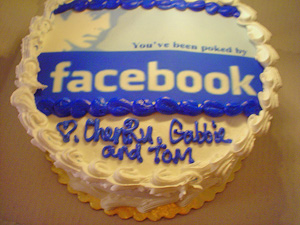
Happy Birthday! Love, Your Wall

Facebook Cake
We all know that the Internet has changed the way people communicate. Some folks think it will completely replace human interaction as we know it. After celebrating my birthday today, you can now add me to that camp.

The Envelope Please

I decided to tally up all the different ways people sent their b-day wishes today. Here's the final count...

In Person - 5 1/2 (4 of which I ran into at an industry event, 1/2 credit to my 15 month old daughter, Eliara)
Phone calls - 8 (2 live, 6 voicemail)
Cards - 8 (pretty much the same people that called)
Text Messages - 3 (1 of which I'm still not sure who it's from)
Email - 5 (including 1 e-card... thanks Grandpa!)
Twitter - 4 (3 @ messages, 1 direct message)
Facebook - 81 (73 wall posts, 5 comments on my status, 2 direct messages and 1 gift)

It's the Thought that Counts, Right?

Now don't get me wrong, I appreciate the sentiment but there's something so very impersonal about a b-day message splattered on your wall after being prompted by a reminder from Facebook.

Of course, I'm guilty of said splattering myself. I used to store people's birthdays in my Outlook calendar and email people on their special day. For a few years, this was quite the effective technique. But I've gotten lazy (not to mention, feel like emails stand out less in a sea of Facebook notifications) and, except for my closest friends and family, just give the ole b-day FB ping these days.

Quantity vs. Quality

So the question becomes -- is this a good thing? I can tell you, I've never had more people remember my birthday nor reach out with b-day love than I did this year. But I've also never had so few phone calls.

There's certainly something to be said for the ease of connectedness that the Internet has brought us. But at what cost?

In the future, will people even talk to each other?

Update 7/12: This post seems to have struck a chord with my friends and family. Apparently I made some people feel a little self-conscious. Sorry, not my intent!

First off, since I published this, another 10 b-day wishes came thru (1 card, 1 email, 1 voicemail and 7 Facebooks).

I also had someone reach out to say that they had wanted to wish me a happy b-day before reading this post but couldn't decide what forum was best. Given our casual but still meaningful friendship, FB seemed too impersonal whereas a phone call would've been too personal. So instead she did neither and decided to wait until we saw each other in person this week. Although she relented after seeing my post and sent an email wishing me a happy b-day and explaining her conundrum.

Over the weekend, this topic came up during a 2-hour roadtrip with some close friends. We talked about how Facebook, and the Internet in general, has changed what it means to be friends with someone. It used to be that if you wanted to know what was going on in a friend's life, you picked up the phone and called. Today, you can keep up with tons of people just by watching your news feed and seeing their updates.

To that end, there was disagreement over whether the Internet helps or hinders friendships. On one hand, it's great to be able to stay connected to so many people and know what's going on in their lives. On the other hand, too often we rely on tools like Facebook to stay up to date on our friends and interact with them much less.

Of course, it's all somewhat semantics and depends on how you define the word "friendship." Personally, I believe the Internet has changed that very definition. To me, now, a friendship is a relationship between 2 people that involves regular offline interaction. Meanwhile, the definition of an acquaintance has been elevated from 2 people that have met in passing to 2 people that stay in touch via the Internet.

It's funny, in so many ways the Internet has facilitated deeper one-to-one relationships -- especially, when it comes to marketers and their consumers. At the same time, though, it has facilitated one-to-many relationships with blogs and social networks allowing us to broadcast our every thought and action to the world. The unfortunate thing is that the true definition of friendship seems to have gotten lost in the shuffle.

Man's Best Friend

Update 7/9/10: The social (media) experiment continues. Today, I posted this update to Facebook and Twitter...

Facebook post
And here's the final tally (well, technically, there are 3 still hours of my b-day left but I will be in no condition to post this at midnight)...

In Person - 5 (2 who work in my office + my wife, daughter, and babysitter)

Phone calls - 13 (8 live, 4 voicemails, and 1 missed call but no message so he resorted to FB)

Cards - 7

E-Cards - 2

Text Messages - 8 (including 2 from South Africa)

Email - 8 (including 1 from Shanghai)

Twitter - surprisingly just 1 (thanks @kosherham) although I did get 1 DM death threat (thanks@saneel) and 1 RT of this post (thanks again @kosherham)

Facebook - 105 wall posts (2 with video), 5 comments on my status, and 1 Like on someone's happy b-day wall post (you're a nerd, Ohloff, but I love ya for it!)

So, once again, Facebook is far and away the most popular method of birthday wishing. And, this year, all my numbers are up (except Twitter) so it looks like 2009/10 featured some good relationship building.

This year, I spent more time thinking about how I responded to the reach-outs than the reach-outs themselves. It's also very telling about this crazy technologically-induced relationship-altered world we live in.

In person - the officemates got thank-you's and fist knocks, the wife and daughter got hugs and kisses and the babysitter got just a thank you (anything more would've been awkward)

Phone calls - I haven't returned any of the voicemails and don't plan to. Anyone that called during the day while I was working (except my parents) was screened out and will have to be ok with going on record as having called (which is probably what they were going for anyway). All the live chats (again, except my parents) took place early evening when I was done working and able to talk.

Cards - I didn't specifically thank anyone for sending cards. Most were from people I also saw live or spoke with live so I figured I didn't need to thank them twice. And for the few that only sent cards, I thought it'd be weird to reciprocate with a call or certainly a written communiqué mirroring the one they sent me.

E-Cards - replied with short and sweet "thank you" emails.

Text Messages - this format seemed to get the most attention from me. I replied to each one with a personalized message. I found it very convenient to see the message when I was good and ready and reply when I was good and ready. Generally speaking, I think texts are a step up on the personal ladder from FB and represent closer friends as they require knowing my phone number and not having the luxury of FB reminding you it's my birthday and being 1 click away from sending a msg. Although I do suspect many of the texters were reminded by FB but I appreciated them going the extra step to grab their cell and fire off a msg.

Emails - replied to each with a "thank you" plus a short personal message (if you count "good wknd" as personal).

Twitter - replied to the death threat with a jab of my own and haven't yet told @kosherham how much I love them but I think they know.

Facebook - so far I haven't responded to anyone on FB, not even the obligatory status update, "thanks everyone for the b-day wishes. It was a great day and I'm so lucky to have such great friends." BLAH and BAH (as in HUMBUG). I'll probably link to this post again and call out the update. If you were one of the FB wishers that saw this status update and read this entire blog post update then I would like to acknowledge you individually because you're either a great friend who's truly interested in my introspective (and self-absorbed) musings or really, really bored on a Friday night. Either way, deserve a little love so leave a comment and claim the affection that's rightfully yours.

Until next year... seeya on FB... or not!

Update 7/10/10: A few more FB reach-outs to report.... 4 more people slipped in wall posts before midnight and I forgot about the 1 poke I got yesterday (thanks, Ma Bell, haven't been poked in years, forgot what it felt like!)

Also, had quite a few people leave a FB comment on my link to this post. One suggested that I make a guesstimate of the number of people that probably saw on FB that it was my b-day but didn't take the time to reach out. So I did some more math and replied as follows...

Good call, I have 742 FB friends and got wall posts/comments/likes/pokes from 125 uniques so 83% of my "friends" were exposed to my b-day reminder (assuming they logged on to FB yesterday and didn't respond)... but as we online media geeks know, exposure does not = view so, between those that didn't visit FB and those that didn't see b-day reminders, I'd say the percent is probably closer to 25% but that's still higher than the percent of my friends that did reach out. Net net, I'm a nerd and no-one cares as much about me as myself. Yeah, yeah, you could've told me that and saved me the math. :)

Then another old friend called me out for not being the best at keeping touch myself. Here was my reply...

Guilty as charged. Notice I didn't report or analyze how many of my friends b-days I've seen reminders for on FB but didn't so much as send a quick poke. Methinks my percentage of exposure to reach outs is probably less than the 17% that did so for me. Guess I'm just a pot poking the kettle.

Meanwhile, another friend sent me this someecard to which I replied, "I could do a whole post on what it says about someone when they use sarcastic e-cards to convey their true feelings. ;)"

I'm not going to do that but I will leave you all with this one...

someecards.com - Thanks for the birthday wishes from everyone who noticed my name today in the upper right corner of your Facebook page

Tuesday, June 16, 2009

Dell Sells The Litter Via Twitter -- But At What Cost?

There's been a lot of buzz over Dell's recent disclosure that it's reeled in over $3mm in sales from Twitter. What I haven't yet seen is the cost-benefit analysis.

Sure $3mm sounds like a lot, especially to journalists who love to point out that Twitter has yet to find a way to make any money at all. But all that tweeting comes with a cost.

Dell has no less than 34 active Twitter accounts. They don't update themselves. (Hey iPhone, is there an app for that?) I counted 24 different people listed as "managing" these various accounts.

Let's assume these folks are paid $50k annually (which is very conservative considering what social media pros are making these days) and add in a multiplier of 2.5 for benefits, overhead, etc. And let's pretend these folks are only spending 50% of their time managing Twitter (although we all know how easy it is to get sucked in and do nothing else all day!)

So we're looking at roughly $1.5mm annually just to cover these employees' time, not to mention any reporting tools or other technology costs associated with managing these Twitter programs.

Now, consider that the $3mm in sales spans June 2007 to date so that's 2 years. Take the $1.5mm annual cost over 2 years and we're at break-even... in the red if you take into account margin on the products sold.

Hmmm, maybe social media isn't such a no-brainer after all. Remember folks, there's no such thing as "free" media.


Update 12/8: Today Mashable is reporting that Dell's Twitter sales have exceeded $6.5mm to which I say, great... but, again, at what cost? Let's run the math again.

Since June of 2007, Dell has generated an average of $2.67mm annually in topline revenue. With a gross margin of 17.3%, that's $465k in net revenue.

With 1.5mm Twitter followers (and 3mm total social media "connections") per Mashable, surely keeping up with the Twitterverse in now a full-time job for Dell's 24 "Community Ambassadors," but let's still assume these folks are only at 50% FTE allocation for managing Twitter et. al.

If each of these staffers are still only making $50k a year, we're looking at total cost of $1.2mm. Add in 20% for benefits and we're at $1.44mm in annual cost. And that does not include any associated direct overhead (eg, equipment, rent, etc.) nor costs for tools to manage the communications, reporting, etc.

So, all in all, Dell is currently seeing a negative net ROI on its Twitter sales. For every dollar it spends, it loses three.

Poster child for social media, indeed.

Update 12/8 #2: Matt Gibbs makes a great point in his comment. If Dell grew its sales via Twitter from $3mm thru June to $6.5mm thru November then it may be ROI positive on its investment in the channel after all.

Indeed, if these figures hold (which is tough to say for certainly because the reported revenue came from 2 different sources), Dell has driven an average of $700k in sales per month over the past 5 months. This translates to $121k/mo. in net revenue which is more (barely) than the $120k in estimated headcount cost.

Of course, if you add in direct overhead and other associated costs as well as consider that the $50k salary and 50% allocation numbers may be light, we're back under water. But, if these revenue growth trends continue, Dell may yet prove that Twitter can be an effective and sustainable platform on a dollar-for-dollar direct ROI basis. If not, it can always fall back on Twitter as a brand-building channel as commenter Irina Skaya posits.

Update 1/14: This post on Mashable brought me out of book hibernation for a brief moment.

The title alone -- "Want to Make Money on Twitter? Take a Look at How Dell Does It" -- caught my eye as another example of the media not taking the full ROI story into account.

Making money means more than just driving revenue. Making money means earning more than you spend. And spend means more than media costs. As noted in the original post here, the costs of social media include manpower, tools, etc.

Then, as I read on, I noticed this nugget from Dell's Twitter czar, Richard Binhammer -- "There are ~ 100 Dell employees using Twitter to connect with customers."

As Borat would say, wowaweewow! Just when I thought Dell had broken into the black on its Twitter efforts -- see previous update above where I had pegged Dell's ROI just north of $1 -- it's back to the drawing board... er, calculator.

My cocktail napkin math was based on an assumption of 24 people allocated at 50% to managing Twitter. Now with the disclosure that roughly 100 Dell'ers are tweeting on company business, it's likely Dell's back in the red.

Let's say those additional 76 folks have real day jobs -- oh no, I didn't just say that... give me hell, social media pro's! -- and just 10% of their time goes to Twitter. And let's assume these people make $50k a year and not take into account any direct overhead or technology/reporting costs. That means we've got another very conservative $30k-ish in costs which brings the total to $150k against $121k in monthly net revenue.

In other words, for every dollar Dell spends to manage its Twitter accounts, it loses about $0.20.

To be sure, I'm not saying this is a bad investment for Dell. As the Mashable post points out, "If you’re simply motivated to make money from Twitter, your heart is in the wrong place. Dell’s strategy is to turn Twitter into an opportunity to build better relationships with customers, which ultimately leads to stronger sales."

Clearly, Dell does not expect a direct positive ROI from its Twitter efforts. For understanding that direct sales are not the only benefit of Twitter as a marketing platform, I applaud Dell. And, for having the sophistication to track sales generated from Twitter, I applaud Dell.

The bone I'm picking here is not with Dell, it's with the media that fawns over Dell's "success" with Twitter and confuses revenue for profit. It's also with all the social media pro's using Dell as the case study as proof that Twitter is the greatest marketing platform since sliced Google.

As with any tactic, to truly evaluate success and "make money", all costs must be taken into account.

Thursday, June 4, 2009

Is it Tweet-Worthy?


Consider this a PSA to all the Twitter newbies (Tweetophytes?) out there trying to figure out what is and is not appropriate to tweet.


For chrissakes, nobody cares...
  • what song you're listening to.
  • that another driver cut you off. (You shouldn't be driving under the tweetfluence anyway!)
  • that the person next to you on the train smells.
  • that you're sick.
  • that you're feeling better.
  • that your Porsche is in the shop.
  • that you're happy it's Friday. (That makes all of us.)
  • that someone is about to go onstage at a panel. (Now, what they say on that panel is a different story!)
  • what you're eating.
  • about a picture of what you're eating.
  • about anything you have to say while you're on the toilet. (Thx @Jacqui_Cooper!)
  • the trials and tribulations of your relationships (hat tip to @KrisMcDermott)
  • how many reps you did at the gym or miles on the treadmill (another one from Kris)
  • that someone else tweeted about you. (In other words, don't retweet a tweet just because you're mentioned in it!)
  • that your plane is delayed... again.
  • what you think of the American Idol voting results.
  • who you think we should follow. (#FollowFriday)

However, we do what to know...

  • what decision you're trying to make? (Maybe we can help!)
  • what funny line you just overheard.
  • what restaurant you really recommend.
  • how good that movie was.
  • where you'll be hanging out tonight. (Just in case we want to join you.)
  • about that awkward situation you just found yourself in.
  • where to find good deals on just about anything.
  • your top 10 lists.
  • where we can find pictures of odd things you encountered during your day. (Just make sure they're funny odd!)
  • what you think of the new Microsoft search engine. (You're enjoying my barrage of tweets about Bing, right @ErikEngman?)
  • what song the band just played at the concert.
  • that you just got arrested.
  • that you just posted something to your blog. (I know some people will argue with me here but I think promoting your blog posts are fair game. Twitter's the new RSS.)
  • what funny headline @TheOnion just ran. (So retweet away!)
  • what you think of the "I'm a Celebrity, Get Me Out of Here" voting results. (Just kidding.)
  • what you think is a #SignOfTheTimes.
So, do us all a favor and next time your ADD kicks in and Twitter is the only thing within reach, stop and ask yourself, "Is it Tweet-worthy?" Oh, and this goes for Facebook updates too, capiche?

Update: @duey23 makes a good point, "What you might NOT find worthy, some mom in Wyoming MIGHT."

And @RonKJeffries weighs in with "chained tweets" as being decidedly unworthy -- aka "RT @abx RT@zxc RT somebody." (If you're that many steps removed from the original tweet, you don't have the right to retweet it!)

Keep 'em coming gang and I'll keep updating this post!

Update 2: Indeed. RT @IanSohn
@AaronGoldman You forgot a classic "Sorry I haven't tweeted all day." Gosh, we were so worried.

Update 3: Here's another to add to the Do-Not-Tweet list -- anything about how much you hate your job or the project/task you're working on at the time. Not only should you be thankful you have a job but your boss or client might read it and you may find yourself soon without one!

Update 7/17: Wondering what the best practices are for corporate Twitter accounts? Just posted, "Is it Tweet-Worthy? Corporate Edition."

Wednesday, May 20, 2009

Is Twitter to Facebook as Google is to Yahoo?

Normally, I don't re-post my entire Search Insider Column to this blog but the last 200 words of today's piece got cut off on Media Post so here's the full version...

Is Twitter to Facebook as Google is to Yahoo?

This analogy came to me at the recent Search Insider Summit during the Day 2 keynote conversation moderated by Gord Hotchkiss with Gian Fulgoni and Jordan Rohan. As always, these SIS-staples delivered many provocative thought-starters but I perked up when they started discussing the opportunity for richer brand experiences on the search engines.

History Lesson

Jordan said that what made Google so popular at first was its sparse page with just a search box and textlinks during a period when the trend was towards meta-cluttered portals. Over time, Google evolved its search results pages to include images, video thumbnails, maps, etc. but stopped short of overtly promoting brands beyond text ads. Jordan argued that incorporating any richer ad unit on the SERP would likely cause consumer-backlash.

I quickly wrote up a post for the MediaPost Raw Blog titled, "It Ain't the Blue Links," suggesting that what made Google so popular wasn't its clean white page with simple blue links but its incredible algorithm and relevancy. I closed with this thought -- "The lesson learned from Google is not just simplicity, it’s automation, crowdsourcing and, above all, relevance."

Lesson Learned?

Google was not the first to do search. That honor goes to Archie. And many other search engines came and went before Google. But Google was the first to take the idea of relevancy beyond mere on-page factors, incorporating an element of crowdsourcing by giving weight to inbounds links.

Today, all the major engines take link-juice into account to some extent. However, the 2 biggest contenders for search share after Google -- Yahoo and Microsoft -- still look at search as an add-on to their core offerings.

Now, let's look at the social networking space. MySpace was the first to reach critical mass (Friendster was close but never tipped) before eventually giving way to Facebook, which came along with what was considered a cleaner UI -- read: less graphics, images, audio and other junk -- and more relevancy -- read: less garage bands, porn, and sexual predators.

But what was it that everyone really liked about Facebook? It was the ability not just to connect with people you actually knew -- it was that you could know what they were doing at all times. The status updates were the golden goose.

Over time, though, Facebook began to become more portal-like. It added more tabs, boxes, app's and pages for brands to market themselves. It rolled out advertising programs that, at best, cluttered news feeds and, at worst, offended people. Oh yeah, and then there was that whole Beacon thing.

Paying Attention?

So, along came Twitter, taking the best of Facebook and stripping out the rest. As @ev and @biz told the hosts on the View, the idea for Twitter was hatched as (and I'm paraphrasing here) "a collection of IM away messages."

But they didn’t stop there. Just like Google took what some where doing already and made it better, Twitter put a twist on the idea of status updates by positioning its platform as “micro-blogging.” In turn, rather than just sharing what inane activity they were doing at the time, the Twitterati use their 140 characters to share ideas, POVs, quotes, tips, even RFPs.

As our collective attention span gets shorter and shorter and ADD is hard-wired into our DNA, people will lose tolerance for platforms like Facebook that require multiple clicks to get to the goods. Navigating Facebook is the epitome of Scott Brinker’s Golden Sprinkle.

Heck, people are even losing tolerance for blogs with the average post seeming like a novel compared to a tweet. Case in point -- with this column closing in on 1000 words, I’m sure many of you are thinking you could’ve just gotten the gist by reading the headline and moving on.

Again, there are parallels here back to the search world. In the late 90’s it became clear people no longer wanted to rely on hunting and pecking around a portal assembled by human editors to find interesting information, they just wanted to search for it and have the algo point them in the right direction.

By stripping out all the superfluous features of Facebook, Twitter is more simple and more relevant.

Demerits

So will Twitter do to Facebook what Google did to Yahoo?

Twitter certainly has momentum. Over the past 2 months, its traffic has quadrupled. And it has become pop culture fodder what with all the celebs on Twitter, Ashton reaching 1 million followers, and Oprah getting onboard. And did I mention the founders were on the View?

There's one major hang up, though. While it may have taken the best feature of Facebook and built a company around it, Twitter missed one key point -- you have to own the audience.

Twitter does not own its audience. Applications like TweetDeck and Twhirl do. And while those app providers are beholden to the Twitter API to power their tools, they’re not affiliated with Twitter nor do they share revenue with it.

The fact is, very few people go to Twitter.com. Sure, it may have 17 million monthly visits per comScore but I'd bet there are well over 50 million active Twitter accounts. (Note: as far as I know, Twitter does not release this number.)

Before Google could build out its syndication network and put its toolbar on every browser and desktop, it first got people hooked on Google.com. That afforded it the luxury of dictating terms to 3rd parties that wanted to build on top of it, either by licensing its search results or embedding its ads onto their sites.

Sure, Twitter could just turn off its API one day, locking out all the 3rd party apps and forcing people to come back to Twitter.com but that will surely cause user-revolt -- much worse than if Google subtly introduced display ads on SERPs.

Another major issue for Twitter is monetization. Enough columns have been written on this topic so I’ll spare you my 2 cents other than to say that what made Google so successful was that its monetization engine reinforced its overall mission -- as Marissa Mayer said, “Ads are answers as well.” And, by keeping them relevant (through its Quality Score) Google’s been able to basically print money.

That said, it’s worth noting that Google didn’t rush to monetize either, taking a couple years to build its audience and work out its kinks before running ads.

Homework

So where does this leave Twitter?

Only time will tell if "status updates” or “micro-blogging" are to "social networks" what "search" was to "portals." And it remains to be seen if Twitter will find a way to drive revenue without disrupting the ecosystem.

If, somehow, Twitter can find the right balance of "simplicity, automation, crowdsourcing and, above all, relevance,” it could very well render Facebook the next Yahoo.

Unless, of course, a Twitter-killer like Flutter or Shttr emerges, stripping out just 26 characters or even going down to 10 and ditching the vowels.

Update: MediaPost corrected the error and my full column is now live on the Search Insider site. Some good chatter in the comments section too. Apparently I was not the first to notice the parallels between Twitter/FB and Google/Yahoo.

Monday, May 18, 2009

Will SPAM derail Social Media?

Is it just me or is there a lot more spamming and phishing going on out there in social media-land lately?

It seems like I'm getting a least a couple spammy messages in Facebook every day now, whether it be via inbox or wall post. And I've already long since given up checking my MySpace account after it got flooded with solicitations from porn stars. Now, the Nigerian princes seem to have migrated to Twitter. Over the past couple weeks, I've been followed by a good 25-30 bots.

When I first broke into the online media biz in 2000, email was the toast of the town. Acquisition email was getting a good 25-50% of our clients' internet advertising budgets and delivering strong response rates. We all know how that story ended. As the channel got cluttered with spam, open and click-rates deteriorated, as did email marketing budgets in turn.

I'm wondering if Social Media is headed for the same outcome. Will people begin to tune out the communications they receive from anyone they don't directly know (including, of course, advertisers) as the platforms become inundated with spammers?

Now, of course, Social Media has gained nowhere near the traction that email marketing did in the late 90's. Facebook, MySpace, et. al. would be thrilled to have 25-50% of marketers' budgets. So their fall may not be as precipitous, if it can be called a fall at all.

Nonetheless, it will be interesting to see how this all plays out. I'm sure the social networks are going to great lengths to keep their channels spam-free but where there's a will, there's a way. And those Nigerians seem to have a lot of will. In fact, one just offered to cut me in on his if I just give him my bank account number.

Thursday, May 14, 2009

You Know You're a Search Geek When...

My new favorite thing is to start Top 10 lists on Twitter and compile them into a blog post.

Here's one I came up with today -- "You Know You're a Search Geek When..."

Happy to see other search geeks get into the action. Keep on eye on #ykyasgw for future contributions.

As always, with my recycled tweets, remember to read bottom up...

derekminer: you know you're a search geek if you follow one?

aarongoldman: You know you're a REDNECK search geek when you and your sig other have fewer combined teeth than characters in your PPC ad titles.

aarongoldman: You know you're a REDNECK search geek when you optimize your PPC campaign via mobile at a NASCAR race.

aarongoldman: You know you're a search geek when you click on a search ad before buying anything online just so that SEM gets credit.

aarongoldman: You know you're a search geek when you finish in the Top 10% of the Biggest Search Geek contest. (I'm #56) http://bit.ly/11i8S2

krismcdermott: @unsavory You know you're a search geek when you follow a coworker's search geek list on the other side of the ocean.

unsavory: You know you're a search geek when you create a 'you know you're a search geek when' list.

aarongoldman: You know you're a search geek when you refer to the Google founders by their first names (and expect everyone to know who you mean)

aarongoldman: You know you're a search geek when you can remember your AdWords password but not your ATM pin.

aarongoldman: You know you're a search geek when you use the word "concatenate" in everyday conversation.

janellandis: you know you're a search geek when the ability to filter your serp excites you http://tinyurl.com/q6x8cs

aarongoldman: "You know you're a search geek when..." --You give your daughter a made-up name to ensure she can get #1 on Google.

aarongoldman: New List: "You know you're a search geek when..." --You swap 404 error jokes over bagels in the morning.

Update 6/4: aarongoldman: You know you're a search geek when you use "Omniture training" and "Love this stuff" in the same tweet. (Ahem, @danperry)

Update 11/16: You know you're a search geek when you're busy blogging about graphical ads on Google SERPs during the last nice weather weekend of the year in Chicago.

Update 11/23: You know you're a search geek when you reference this post in a blog post of your own.

Tuesday, May 12, 2009

Tilting the Tweet-o-meter

My Search Insider column (and, as I pointed out to @oliman on Twitter, I use the term "column" loosely) ran today. First time I've run on a Tuesday. MediaPost had a last-minute lineup shuffle in the wake of David Berkowitz heading to the Social Media Insider. Not to worry, I'll be back to my every-other-Wed. slot in 2 weeks.

As promised, this edition recapped the top 10 buzzwords from the Search Insider Summit.

Here they are:

1. Twitter
2. Attribution
3. Exchanges
4. Last-Click
5. Bless You, Gezundteit (tie)
6. Economy, Recession (tie)
7. Free, SEO (tie)
8. Affiliates
9. Social, Mobile (tie)
10. Osprey

In terms of my predictions for how the Buzz-o-meter would shake out, I batted .400 -- not bad for a baseball player, pretty lousy for a Search Insider. Oh well, as a true Cubs fan always says, wait til next year!

Wednesday, April 29, 2009

Search Insider Summit: Who's Ready to Catch a Buzz in Captiva?

In today's Search Insider column I break form from past conferences and offer a predictive Buzz-o-meter for next week's Search Insider Summit.

Here are my speculative Top 10:

1. Twitter
2. Google
3. Recession, Opportunity (tie)
4. Attribution, Post-Click (tie)
5. Local
6. Microsoft, Live Search, MSN, Kumo (tie)
7. Social Media
8. In-House
9. RFP
10. No-see-ums

As always, my next column will reveal the actual topics that had everyone buzzing. And I'll be sharing all the best sound-bytes on Twitter so make sure to follow me if you don't mind a dizzying array of tweets.

Wednesday, April 1, 2009

Does the Carpet Match the Drapes?

As I hinted at in my Hunch review, today's Search Insider builds on the topic of why people search to explore why search marketing is so prolific -- and how important it is that the point of both search and search marketing match. In that framework, I ponder what it would take for a new platform (ala Hunch) to leapfrog Google.

Here's the blurb...

What's The Point Of Search Marketing?

In my last column, I tried to put some context around future search innovation by asking, "What's the point of search?" Cribbing from Wikipedia's definition for matching theory, I landed on solving problems by using math or science to remove friction and create economically favorable outcomes for all. If this, indeed, is the point of search, then what's the point of search marketing?

Wednesday, March 25, 2009

OMMA Hollywood Tweetlights

Those of you who follow me on Twitter know that I'm a tweet-machine at conferences (and debates). I will literally clog your feed for hours on end. There's just something about trade shows and Twitter that go so nicely together. 140 characters is just enough to pass along a great quip, hot buzzword, or thing that makes you go hmmm...

For those of you that don't follow me or de-followed me following my tweet-burst over the past couple days at OMMA, I've culled some of the high, er... tweetlights here:

Hearing the word "ecosystem" a lot -- thankfully haven't heard "win, win."

Just got an email w/ this quote in the footer: "Don't worry about the world coming to an end today. It's already tomorrow in Australia."

Never thought I'd hear the word "gesticulate" during a keynote but @johnbattelle just dropped it

@johnbattelle refers to FM as "agency of record for publishers" -- certainly sounds better than blog ad network!

This note just handed me: "Twitter is for agency A types that can't sit still in conferences of airports." Guilty!

Joe Mandese of MediaPost just called his panelists "friction taker-outers"

Tracey Scheppach of Starcom wins today's buzzword bingo: "Consumers want non-intrusive, privacy-sensitive, addressable ads" BINGO!

Pet peeve - people who call it a "SERP page." The P stands for page!

Bill Leake of Apogee Search: "Today's online videos ads are basically TV ads, only shorter and grainier."

One of the buzzwords I'm hearing that I actually like is "Earned Media" (SEO, PR, Social, etc.)

Bob Heyman of Mediasmith: "SEO is not free. Not anymore than PR is free."

I loathe when digital marketing companies refer to their "secret sauce." C'mon now, you're not Coca Cola.

@jasoncalacanis: "Engagement is a term that people who have ads that don't work use."

@jasoncalacanis: "Punch the monkey had great engagement but you don't see Volvo or Apple using it."

@johnbattelle: "If engagement is bullshit, then I call it fertilizer."

Ian Schafer of Deep Focus says his firm brands itself as an "Engagement agency." Cue @jasoncalacanis.

I hate when speakers refer to people as "users." Searchers are not users. Website visitors are not users. Drug addicts are users.

@jasoncalacanis: "Google is indexing all the world's information. The problem is the world's information is largely bad."

@jasoncalacanis: "Jimmy Fallon has 400k Twitter followers. That's definitely more people than are watching his show."

Just finished my panel. Best line-Jeremy Barnes of Acquity:"5 years ago I'd have said if you need on-site search you have bad IA."

Gian Fulgoni of comScore on why media $$ will continue to flow to TV: "The CEO's wife still loves seeing the company on TV."

Angela Courtin of MySpace wins buzzword bingo: "Brands can be idea-amplifiers.... multiple touchpoints... convergence..."

Paul Kedrosky - sign of our ignorance... 2nd most popular on WSJ in 2008 was "China easts crow over photo of rare antelope"

"Cocooning" is the hot buzzword these days. Refers to people staying at home and not spending $$. Kinda like a permanent "Staycation"

Monday, March 23, 2009

Twitter Monetization

Twitter

I've heard all the ideas for how Twitter can make money:

- Charge a subscription fee for using the service
- Charge businesses for corporate Twitter accounts
- Sell the Recommended User placements (which Jason Calacanis has offered $250k for)
- Sell sponsored tweets that would appear in your feed (ala Twiterrific)
- Charge for re-tweets

Now I'd like to add mine...

- Charge 10 cents for each character over 140 per tweet.

Who hasn't found themselves struggling to shorten their thought to meet Twitter specs? Are you telling me you wouldn't pay $1 to get that last word in? And surely corporations would pay a good $5-10 per tweet to deliver an extended commercial message to their followers. Still cheaper than a CRM email blast. And they'd be even more inclined to pay up if tweets over 140 characters received some sort of premium placement in people's feeds.

What do you think? Is micropayments for overage the silver bullet for Twitter?

Update 3/24: Here's one more way for Twitter to monetize...


Twitter Monetization revisited

Yesterday, I executed the first (as far as I know) successful drug deal via Twitter. Granted, it was just an OTC decongestant but Danny tweeted that he was stuffed up and I happened to be nearby with a pill in my pocket. I'm sure Danny would've been happy to pay Twitter a commission for brokering that deal.

Update 9/16: Just posted to the Connectual blog on 4 ways Twitter can make money through advertising without pissing off its user-base and delivering strong ROI for marketers.

Wednesday, March 18, 2009

Pointing to the Point

In today's Search Insider column, I try to put all the buzz around Twitter and it's application to search in context. Rather than annoint the "real-time search engine" as the Google killer, we need to really think about what the point of search is. I don't think it's about finding results or even answers (regardless of if they're "real-time") -- it's about solving problems. And I don't think that can be done in 140 characaters.

Here's the blurb...

What's the Point Of Search?

I've tackled some heady questions over the years as a Search Insider -- "Why Can't Everything Be Searchable?" "Will Search Personalization Create Self-Fulfilling Prophecies?" "Should We Fear Ambient Findability?" "Is MyLifeBits the Future of Personalized Search?" And who could forget, "Is Search Rocket Science?" Today, I'll go for the jugular: What's the point of search?

Tuesday, March 17, 2009

We Tweet, WeFollow

I'm quoted in Media Post today on an article about WeFollow.

Bascially, WeFollow is a user-generated Twitter directory. It allows you to select 3 categories by which your profile can be listed. I found it really hard to describe my Twitter profile in just 3 ways. And I'm sure marketers will find it just as difficult.

I suppose, just like search marketing, the key is to choose keywords that have the right balance of popularity, relevance, and opportunity to win. The ones I chose were #marketing (I'm #683), #digital (I'm #15), and #sem (I'm #41).

In the Media Post article, I share 3 prospective ways marketers can leverage this new Twitter directory:

1. Determine who the key influencers are in their categories and conduct outreach to them to engage with or discuss their product/service

2. List yourself in the appropriate category to increase exposure

3. At some point it's likely WeFollow will create advertising opportunities or sponsored listings once it reaches critical mass

Here's the blurb:

Digg Founder Unveils WeFollow Twitter Directory
by Laurie Sullivan
Digg founder Kevin Rose has developed a Twitter directory to support real-time search to make sense of the mounds of data available through the network. The tool, dubbed WeFollow.com, allows Twitter users to associate themselves with up to three tags that identify them as having expertise on a specific topic. Twitter will index the account under the appropriate category on WeFollow.com. ... Read the whole story > >

Related Posts with Thumbnails