Showing posts with label Search. Show all posts

Friday, August 27, 2010

Getting My Groove on with Groupon


Image Source

In this week's Search Insider, I continue my "sexy search" theme. Here's the blurb...

50% Off Top-20 List About Groupon and Search

In my ongoing campaign to bring sexy back to search, I thought I'd take one of the hottest companies on the interweb and relate it to search marketing. Groupon is everywhere. From your inbox to the "Today Show," you can't escape the appeal of collective buying power. Here are 50% of the top 20 ways search marketing is sexy like Groupon. Note: if 100 people give this column a thumbs-up, I'll share the other 50% in my next column.
» 1 Comments

Saturday, August 14, 2010

I'm Not Too Sexy (yet)

Image Source

In this week's Search Insider column, I riff on a Justin Timberlake tune to illustrate my point about making Search sexy again. Hopefully, my POV will resonate and I'll have to switch over to Right Said Fred's mantra in the near future.

Here's the blurb...

Bringing Sexy Back to Search

Search has become a bit boring. It doesn't get the headlines. It doesn't pack the halls at conferences. It doesn't trend on Twitter. But still: From social to mobile to video to display, key attributes of SEM are being incorporated into emerging online ad platforms and content development best practices. And it won't be long before the convergence of the online and offline world -- see Google TV -- brings the search mojo to traditional channels. Here are 10 reasons why SEM professionals are positioned well to rule the marketing roost:
» 2 Comments

Thursday, July 29, 2010

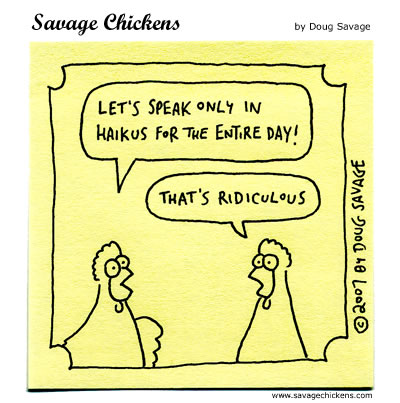
Googley Haiku


Image Source

I've often compared writing search ad copy to conjuring Haiku. Those darn specs can be infuriating! Every time I pen one of these columns I'm reminded how valuable good search copywriters are.

So Few Characters.
Want To Add More Nouns And Verbs.
And Here Is The Blurb...

The New Haiku -- 2010 Edition

Anytime I find myself in a pinch for column fodder, I know I can always fall back on a little Search Haiku. It's not as exciting as covering the search news blotter, but hopefully it will still be as entertaining for you. So here is a fresh new installment of rhymes adding to my collection from '06 and '09.
» 9 Comments

Wednesday, July 7, 2010

Google Who?

Woe is me for having branded myself (and my wife) with the Google Me moniker. As rumors fly over a Google social network named Google Me, I'm ducking for cover from Google's lawyers (would they really come after someone who just wrote a book singing their praises!?!) and frantically planning modifications to my t-shirt line (available today via KosherHam.com -- get 'em while they're hot... and legal!)

In last week's Search Insider column, I touch on Google Me (the network, not the shirt... well, ok, the shirt too!) in the context of Facebook's move to use the social graph to influence search results. Will flesh out the Google Me piece more in next week's column.

Here's the blurb...

Link Vs. Like And The Future Of Web Ranking

There's been a lot of discussion about the ongoing fight for Web supremacy between Google and Facebook but, to date, the debate has centered around matters like privacy and metrics like page views and ad dollars. In the past week, however, it appears both companies are taking direct aim at the heart of the other's core business. First, AllFacebook.com reported that Facebook launched an "open graph search engine." Then, Kevin Rose sent the blogosphere into, well, the stratosphere with a tweet suggesting that a new Google social network called "Google Me" is imminent. In today's column, I'll dissect Facebook's search aspirations.
» 2 Comments

Monday, May 24, 2010

Putting the KITT in Kittlaus

Knight RiderImage Source

In last week’s Search Insider column, I share the complete transcript of my interview with Siri CEO, Dag Kittlaus.

I conducted this Q&A in the context of exploring the future of search for my book. Chapter 21 is titled “Future-Proofing” and takes a look at what the world of Google will look like 10 years from now and how marketers can best prepare.

Without stealing thunder from my book, the short story is that the future of search will look nothing like the keyword-triggered results we get today. As app-ssistants like Siri complement -- and eventually replace -- Search Engines, we’ll see instruction-triggered actions leveraging intimate knowledge of our preferences.

And, with Apple now owning Siri, we may also see a shakeup of power among the key players in the space.

Let’s just hope the next wave of virtual digital assistants leaves the Hoff behind.

Here’s the blurb…

A Siri-es Of Fortunate Events
Posted by Aaron Goldman on May 19, 10:07 AM
To be sure, Siri is not yet ready for prime time, but it has all the makings of a Siri-al Google Killer. And, with continued investment from Apple, it's not unreasonable to think that Siri could do to search what the iPhone did to phones -- that is, completely change the way we think about them from both a consumer and marketing standpoint. Here's my chat with Siri CEO Dag Kittlaus.
» 3 Comments

Wednesday, May 5, 2010

I am Siri-ous and Don’t Call Me Shirley!

Leslie Nielsen AirplaneImage Source

As promised, in today’s Search Insider column, I cover Apple’s acquisition of Siri in the context of its ambitions to change the way we think of mobile and search marketing.

I asked my Twitter followers to weigh in with other good Siri puns and @telerob inspired the title to this post. Here are some others I like:

1. Siri-al (Google) Killer
2. Mis-Siri Loves Company
3. A-Siri-an Nation
4. World Siri-es Champ
5. Look out Siri-han Siri-han
6. Siri-sucker Suit
7. Montes-Siri Education
8. Siri-ndipitous Turn of Events
9. The Sooth-Siri Sees All
10. Healthy Does of Triglyc-Siri-ide

In my next Search Insider column, I’ll share highlights from my interview with Siri CEO, Dag Kittlaus. Meantime, I need to Siri-ously get a life.

Here's the blurb...

Apple Is Siri-ous About Search

Nearly one year ago, fellow Search Insider Gord Hotchkiss declared, "Search needs an iPhone." With this "mobile Web and computing device.... [Apple] intended to vault over the competition, changing the rules and opening a new marketplace. Apple strategists had nothing short of revolution on their minds."

Two recent events make it pretty clear that Apple feels the same way about search as it does/did about the phone.
» 5 Comments

Friday, April 23, 2010

Wish I Were There

Wish You Were Here


In this week's Search Insider column, I collaborated with Frank Lee of The Search Agency to recap the highlights of the MediaPost Search Insider Summit. (Frank attended the conference in person while I monitored it live via Twitter #mpsis.)

In my last column, I shared predictions for what would have people buzzing in Captiva. Turns out I got 4/10 right -- 5 if you count Attribution as a variation of Data. Not a bad average for a major league baseball player. Not great for a guy who's been closely tracking SIS buzz for eight shows running.

Here's the blurb...

Search Insider Summit Buzz-O-Tweeter

Last week saw the annual spring migration of search geeks down to Florida for the Search Insider Summit. After attending the previous seven shows and tracking the buzz, I had to turn the reigns over to Frank Lee of The Search Agency for on-site buzz tracking -- which is very scientific, mind you -- and settle for remotely monitoring the #mpsis tweet-stream. Here are the top ten buzzwords dropped by conference attendees, with some context for each one from Frank -- and a little added commentary from me -- along with the tweet I think best captured the sentiment.
» 2 Comments


Thursday, April 8, 2010

Buzz Lightweek?


In yesterday's Search Insider column, I offered up a preview for next week's Search Insider Summit, a conference that I've attended each of the past 7 times but will be missing next week due to family commitments.

At each SIS, I track the Buzz-o-Meter -- the ten most popular buzzwords dropped by speakers and attendees. In this column, I recap that past 7 lists and take a stab at predicting what will have people buzzing next week.

We'll see if my predictions come true or if it turns out to be a buzz-light week.

Here's the blurb...

Captiva Weather Report: Sunny, Warm, And Chance of Buzz

Next week, many of my friends and colleagues will be descending upon Captiva Island, Fla. for the biannual Search Insider Summit. In today's column, I'll share the results from the past seven summits to see what trends we can identify and help people "skate where the puck is going" or, more appropriately, "sail where the boat will be" in Captiva.
» 3 Comments


Sunday, March 7, 2010

OMMA Gawd, This is Gonna Be Good!

OMMA Global SF
In a couple weeks, I'll be moderating a panel at OMMA Global in San Francisco. This conference is put on by MediaPost and, for the first time, track sessions will be free to the public.

Rather than sharing the topics and questions for my panel in the rear -- like I did for last week's CIMA event -- I thought I'd put 'em out in advance so people can get a sense for what we'll be covering and weigh in with feedback prior to the session.

Now I can check the buzzwords "transparency" and "crowd-sourcing" off my to-do list. (Speaking of transparency, I should point out that I'm compensated by MediaPost for programming the search track of this conference.)

Below is the prep sheet I just fired off to my panel. I'll be sure to update this post after the session with the highlights. Meanwhile, let me know what else you think we should hit on.

And, if you happen to be at the event, instead of Buzzword Bingo, we're gonna play Freestyle Fodder. Print out this post and keep track of how many Q's I actually ask versus ad-lib.

OMMA Global
Marriott Marquis
55 Fourth Street, San Francisco, CA

March 18, 2010
11:30am

Is Your Company Spending Too Much on Search?

Search may be the last click for customers who are buying what you have to sell. But that click often comes at the end of the consumer’s online marketing journey -- which includes exposure to banners, video ads, mobile messages and various other marketing techniques. Up to now, search has gotten much of the credit -- and the budget -- for making the sale. Smart search experts, however, recognize they don’t operate in a void, and more of them are studying and reporting how their discipline works in conjunction with other forms of marketing. They believe that by showing you the impact of marketing dollars spent "upstream," they can accurately address if your company is spending too much or too little on search. Others, however, are not so sure. This panel will discuss the unpredictable effects of search’s evolving upstream approach. Could it be a minefield for the search industry or will search finally step into the role as your strategic adviser? Find out what you have to gain either way.

Panelists:

Chad Baldwin, VP, Sales, North America, Kenshoo

Gerry Bavaro, VP, Managing Director, Resolution Media

Mike Moran, Chief Strategist, Converseon

Esco Strong, Director, Analytics, Microsoft Advertising

Moderator:

Aaron Goldman, Managing Partner, Connectual

Questions for the Panel

(Note: I will not get to all of these and won’t ask them in this order so be ready to improvise with me!)

Update 3/19: Well, I made it through half the Q's. See below in italics for choice sound-bytes from the panel. All in all, it was a great session. Thanks to my panelists for sharing their wisdom and to everyone who turned out in the audience!

Role of Search in the Mix

Before we can talk about proper budget allocation between search and other channels, I think we need to talk about the role of search in the marketing and media mix. Now, of course, this will be different for each marketer but give our audience a framework for how to think about the role search can play for their business? What part of the purchase funnel does search address?

Chad: Over 50% of new customer acquisition comes from search

Gerry: Search is part of a long trail. (AG: Hopefully it’s a happy trail!) You have to walk before you run.

Mike: Search is not a tool, it’s a moment in time. You don’t ask what the role of the telephone was in driving sales, do you?

When we talk about “spending too much on search,” we can be referring to many different things -- media costs for paid search, labor costs for natural search, technology costs for both and, certainly, opportunity costs for both. How does the approach to this conversation change if we’re talking about paid search or SEO? Or does it not change at all?

Gerry: Think about bucketing media into paid, earned and owned

Chad: Need to track every single event to conversion

Esco: It’s not about asking if I spend too much on search, it’s am I spending it in the right way or am I spending enough on other channels?

Mike: When it comes to SEO, many people don’t think about it until after they build the website. That’s like building a house and saying, “OK, now we need to figure out the plumbing.”

Big Picture

Mike reminds us that before we get into discussing advanced attribution modeling, we need to consider that most businesses that sell their products and services offline can’t tell what happened online to result in a sale. What are some basic best practices for these companies?

Mike: Too many clients think, “We went into marketing to get away from the math.” Don’t focuse on numbers, focus on answers or insights.

Best Practices

As we move into the online arena, where tracking is most robust, it’s clearly a challenge to isolate the impact each touchpoint has on your brand from search to display to social to mobile. How does one get started on building a basic attribution model?

Mike: Do it wrong, quickly. Whatever you do will be better than doing nothing.

Once you have a working model and data coming in, what’s the best way to analyze and act on that data? Is it just about redistributing credit for sales? Or are there other ways to apply this data?

What’s the biggest challenge to getting attribution right?

What’s the biggest mistake you see people make when it comes to attribution and budget allocation?

Can you share some examples of companies that have successfully created and applied attribution models to drive more marketing ROI? What typically happens to the credit for sales that search gets in these situations? More, less, same?

Players

Who needs to be involved in the allocation and attribution conversation? Which departments internally within the corporation? Which external partners? From an agency standpoint, who needs to be involved?

Mike: as few people as possible!

Ultimately, who should have ownership?

Tools

What tools and technologies are available for marketers and agencies looking to determine the proper budget allocation and attribution models for their business?

Chad: it’s a statistical problem. At Kenshoo (alert: sales plug!), we have PhD's working on technologies that can help solve it.

Will we ever get to the point where we can take people out of the equation and the technology can “do it all?”

Esco: it’s equal parts art and science.

Future

How do you think the attribution conversation will change in the coming years?

In 5 years, what will we be talking about on panels like this at conferences? Will we still have attribution and allocation panels at conferences?

Audience Q: How do you get everyone at the table to tackle these thorny issues?

AG: Free food!


Wednesday, December 16, 2009

Search and Social: See You at the Crossroads

Search and SocialImage Source

The intersection of search marketing and social media has been a hot topic lately. I've weighed in on it with posts like Search and Social: Wherein Lies the Truth?, Search and Social: Playing Nicely Together and Is Social Media the New Search?

I also moderated a session at SES Chicago on the link between search and social. I teased up my panel in the post SES Chicago Preview and Shameless Self-Promotion and then recapped it with SES Chicago Search + Social Session in Pics.

I also did an interview for Webmaster Radio with Marshall Clark at the conference on "Social Search and Distributive Reputation Systems."

For more context on that last thread, check out Marshall's deck below. I've also posted the PPTs from the other 3 gents in my session with their permission. As you'll see, we have 4 very different takes on the topic. Feel free to comment here or reach out directly to the presenters with feedback.

I'd like to thank each of the panelists again for their participation pre, during, and post-session. All I can say to you fellas now is that, with your decks forever enshrined on Slideshare, tell me what you gonna do when there ain't nowhere to hide, when judgement comes for you cuz its gonna come for you!

Keepin' 'Em Buzzin'

BuzzImage Source

Today's Search Insider column features the bi-annual Search Insider Summit Buzz-o-Meter. Take a flyer (get it, fly-er?) to see what you missed in Park City a few weeks ago.

Here's the blurb:

Search Insider Summit Buzz: Get Your Cut

In a world where real-time is becoming the only time, I feel like a bit of a dope relaying the Search Insider Summit Buzz-o-Meter nearly two weeks after the event. Alas, it's just the way the publishing schedule shook out this season. So here goes.
» 1 Comments

Thursday, December 10, 2009

SES Chicago Search + Social Session in Pics

SES Chicago Social + Search SessionAfter some shameless promotion, my SES Chicago session on the link between Search and Social was well-attended and well-received.

You can see the panel assembling in the pic above. From right to left that's Bryan Simkins of FedEx, Marshall Clark of Organic, Tobias Peggs of OneRiot, Brian Boland of Facebook and yours truly. Hat tip to Chad Richards from Firebelly for the TwitPic.

The content was quite diverse reflecting the individual POV of each speaker and his respective company.

By way of quick recap...

Marshall outlined his Page Rank for People postulate.

Then Tobias broke down One Riot's Pulse Rank algorithm.

In turn, I joked with Brian that Facebook should roll out Poke Rank. He didn't take the bait but did demonstrate how the Facebook ad platform incorporates some of the same concepts as SEM.

Bryan wrapped things up by tackling the recency vs. relevancy conundrum that's surfaced with Google's integration of real-time results onto the SERP by pitting man vs. machine.

I just asked the panelists for permission to post their presentations. As soon as I get that, I'll add their decks as an update to this post. In the meantime, here are some images that represent the highlights of the presos. You'll have to check back for the full context -- although the Alt Tags will provide some clues.

Marshall's take on bald Matt Cutts
Tobias riffs on Sergey and Larry -- the world's most famous librarians
Boland exposes a coworker's friends
Bryan insisted that this was not a self-portrait
Bryan took us undercover to find the link between search and social
Bryan lamented the day SEM became uncool
Deep Blue is to Google as Kasparov is to Twitter
Marshall bragged about his agency creating the first banner ad ever
Bryan made fun of the Average Joe moderating the session (I do get Vince Vaughn a lot)
Bryan pointed to Aristotle as an early infomediary
Bryan's main point, on the other hand, was very easy to grasp
Bryan did his best to keep his preso clean

Update 12/18: Rather than update this already long and visual post with the decks from the session, I decided to create a new post to house them -- Search and Social: See You at the Crossroads.

Monday, December 7, 2009

Google Real Time Search Optimization

Today, Google rolled out Real-Time search integrated into the SERP's. And just like when I heard about Bing's Twitter integration, my first inclination was to try and get myself a page 1 ranking. Sure enough, it wasn't that difficult...

Here's a screenshot of the (fleeting) results for the query "Google Real Time Search."

Google Real Time Search

And here's a closeup...

Google Real-Time Search
The presentation of these results is interesting. They're called "Latest Results" (presumably, because no-one outside the digital marketing world knows what "real-time" means) and they auto-refresh nearly every second with a "pause" button available to stop the madness. There's a scroll bar to the right which helps this set of results really pop on the SERP. For straight articles and blog posts, the results look like any other Google news result but, for tweets, the listings appear in a cute little talking bubble.

This is the first time I've seen Google embed anything on its SERPs with auto-motion, as opposed to static listings. It certainly draws the eye to these results. I wonder if this is a precursor for richer ad units. Get people used to seeing movement on the SERPs and then hit them with ads that float around and whatnot. OK, that's probably a stretch but a guy can dream, can't he?

Update 12/9: Today I tried doing an entirely knew kind of Google bomb. I was curious if Google and/or Twitter were filtering tweets that get pulled thru to Google.com. So I dropped an f-bomb in a tweet and nervously monitored the SERP. Sure enough, it never saw the light of day on Google. And just to be sure it wasn't an anomaly, I let another tweet fly with the same keyword sans f-bomb and, sure enough, it was picked right up...

Saturday, December 5, 2009

Search and Social: Playing Nicely Together

Play NiceImage Source

Day 3 of the Search Insider Summit brought a keynote with Chris Copeland of Group M and Graham Mudd of comScore on the interplay between search and social. They covered the key findings from research released in October.

When I first read the press release about the study, I was struck by how much the results seemed like no-brainer (even potentially misleading) material and posted an admittedly hasty response -- Search and Social: Wherein Lies the Truth.

So I was excited to have the opportunity to see the research presented live and share some of my thoughts on how the data was interpreted. Sure enough, as he took the stage, Chris (justifiably) called me out for the hasty post -- although, in my defense, at least I was transparent about it -- and assured me that he'd leave 5 minutes at the end for my questions.

The data Chris and Graham presented was certainly compelling. I won't rehash it all here as it's available through Group M Search. The basic gist is that they saw significant lifts in search query volume and click-rate when consumers were exposed to both search and social media vs. search alone. These lifts were more pronounced when looking at campaign brand terms (32 point lift), brand product terms (42 pts) and general product attributes (21 pts). Chris pointed out that this demonstrates the impact social media can have on influencing the consideration phase of the purchase funnel.

A few times during the presentation Chris suggested that marketers may be investing too much in their paid search programs to maximize coverage on top-of-funnel terms when siphoning some of that budget off to social media could more effectively drive consideration and, in turn, marketers could capitalize by buying lower funnel (typically less expensive) terms.

After the presentation, I began my comments by applauding the research and recognizing that there's not enough research about the interplay between search and social so any data is good data. However, as I mentioned in my previous post, it seems like you could replace social media with any other marketing tactic or media channel and find the same results -- that the combination of Platform X plus search drives a lift over search alone. After all, people need to be motivated by some external stimulus to search.

In fact, a few years ago, iProspect put out a study that showed that 37% of all searches were influenced by TV and 30% from print. Accordingly, I asked Chris if it might make more sense to reallocate dollars from search to other media channels besides social if the end goal is driving a higher search response (which was the only metric measured in the Group M/comScore report).

Chris acknowledged there are a number of different directions they could've taken this research and reiterated that they plan on releasing a phase 2 report with deeper analysis into conversion activity. But he reminded me that, when it comes to budget allocation, this is not a zero sum game. Most clients aren't maxing out their paid search opportunity, much less fully-funding other channels. As Chris sees it, the data from this study should help justify increased investment in social media but where that budget should come from will depend on each marketer's unique situation.

Other areas that they plan to dig deeper into for the phase 2 report include categories beyond auto, CPG and telecom. Comparing the lift relative to other channels is not on the docket but something they may explore down the road. I also asked if they'd be able to break down the components of "influenced social media" futher to see what impact things like FB fan pages have vs. iPhone apps but Chris pointed out that it's tough to isolate these platforms because they don't really have a 1-to-1 relationship with the consumer. In other words, they all work together to influence the consumer and not independently in silos.

All in all, I was satisfied with the rationale Chris and Graham provided for how this study was set up and what they set out to prove. It's more about just understanding the impact of social on search and less about making sweeping recommendations and advocating for specific budget reallocation decisions. In this context, I certainly agree that the mission was accomplished and look forward to seeing how they build on it for phase 2.

I'll be getting into this topic again on Monday in my SES Chicago panel -- more info on that session in my post, SES Chicago Preview and Shameless Self-Promotion. Look forward to continuing the dialogue there and in the blogo/twitter-sphere.

Update 12/16: Just posted the 4 decks from my SES panelists. Great stuff from Marshall Clark of Organic, Tobias Peggs of One Riot, Brian Boland of Facebook, and Bryan Simkings of FedEx. See "Search and Social: See You at the Crossroads."

Friday, December 4, 2009

Search Engine Idol: and the winner is...

Update Dec. 2, 2010: Milo acquired by eBay for $75 million. Hope no-one forgets where Milo got its big break!

Congrats to Milo on winning the first season of Search Engine Idol at the MediaPost Search Insider Summit today.

It was a hard fought contest with Milo scoring the max 100 on the crowd-o-meter (using this awesome PPT template from SAP). Second place went to Goby with a 97. Search3 was appropriately 3rd with 96 (skewed by David Fireman's self-clapping close to the microphone) and 4th was Info.com (disclosure: Connectual partner) with a respectable 76. Unfortunately, Factery Labs had to bail last minute and couldn't participate.

Another cool PPT integration from SAP that I used was a streaming tweet bar at the bottom of the slide. Here's an abridged recap of the chatter...

MikeMoran: Watching demo of Milo search engine that locates products in physical stores near you--even clothing. #mpsis

telerob: #mpsis - milo.com uses a dog? Hello Lycos rip off.

Eric_Hoffman: "Future of search is about context" per Mark Watkins of Goby, very true. #mpsis

jefffig: Goby is pretty cool. Just tried Arts & Culture in Salt Lake for tomorrow and got relevant results. #mpsis

telerob: Goby contextual search engine is unique but no reason bing or google couldn't replicate this and crush them. #mpsis

mattkdecide: Can I make the big screen? Wow I'm famous. Hi mom! #MPSIS

outofmygord: #mpsis Search3 interface just doesn't work for users..too complicated..asks too much from user. Doesn't scan well

MikeMoran: Now we are seeing Search3 at #mpsis, which does comparisons of search results across engines

janellandis: dont future search engines that want to compete with google need to simplify the process? methinks search3.com complicates it. #mpsis

telerob: the Search3 is meh. Nothing of interest. #mpsis

HeidiJack: Milo.com v. Goby v. Search3 v. Info.com competition #MPSIS Milo would rock on the phone! Goby great categories with pics, Search3 compiler

chiefmartec: what if Aaron Goldman's desktop background wins best UI in search engine idol #mpsis

MikeMoran: Now looking at info.com at #mpsis which is a meta search engine with deeper vertical provider relationships (e.g., become.com for shopping)

telerob: Some one wake me when info.com is done. #mpsis

cknoch: #MPSIS tweets in preso has me reading the Tweets instead of paying attention to the preso :)

cdanuloff: Moby and Milo are well executed & useful vertical engines - lots of value add. Info.com and Search3 are good ideas but not there yet. #mpsis

aarongoldman: First season of Search Engine Idol was a hit! Congrats to Milo.com (@wherecanibuy) on winning and thx to all contestants & judges. #mpsis

Looking forward to season two of Search Engine Idol at the next SIS in April. Thinking of mixing things up and having Rob Griffin (@telerob) sit on the judge's panel. We'll see if he's as Simon Cowell-esque when he has to actually say it to the faces of the contestants.

Another change I'm considering for next time is making all the contestants do the same query in their demo (and not telling them in advance what that keyword will be). Methinks that'll level the playing field pretty well.

Thanks again to all the contestants and judges (Charles Knight of AltSearchEngines.com, Robert Pettee of Lending Tree, and Mark Scholz of HP) as well as the audience for keeping things lively.

And congrats again to Milo for fetching the top spot!


Update 12/8:
MediaPost just posted the video of Search Engine Idol to the gallery. I've embedded it here so, if you missed the event, you can see all the action. Enjoy!

Sunday, November 22, 2009

Search Wars: Desperate Times Call for Desperate Measures

Image Source

Unless you've been living under a rock, you're aware that Rupert Murdoch has been threatening to remove News Corp properties from the Google index as a means of punishing the Big G from profiting from its content. Many have weighed in on the pros and cons of such a move.

Today brings an interesting plot twist though. Apparently, Microsoft is offering to pay News Corp to "de-index its news sites from Google." According to the Financial Times, "Microsoft has also approached other big online publishers to persuade them to remove their sites from Google’s search engine."

Microsoft seems to have no limits to its scramble to catch Google. After spending millions to launch Bing, it struck a distribution deal with Yahoo but everything MSFT gained in share from Bing, Yahoo has since lost.

It looks like Microsoft realizes it can't catch Google just by improving its own product or aligning with other contenders. It has to cripple Google itself. But, will paying big publishers to remove their sites from Google be enough to break the Google Habit? I'm not so sure.

Frankly, I don't think that many searchers would realize that News Corp sites are missing from the index. Google has no shortage of other sources to cite for queries related to News Corp content so people will just get their news or entertainment from other places. Google is one of the top brands in the world. News Corp is not. Google is the source the masses trust when seeking information. News Corp is not.

It would take a coalition of all major news outlets to boycott Google for this to be a meaningful coup. And I don't think others are willing to cut off their nose to spite their face the way News Corp is ready to do. (After all, if I'm Turner and I just saw Murdoch remove his properties from Google, wouldn't I be thrilled to have that traffic come my way?) And, even if they would, there's plenty more to Google than just news search. In fact, who really searches for news anymore? Don't we all just lean back and let Twitter tell us what's going on in the world?

Meanwhile, while Microsoft is putting all this horsepower into figuring out a way to catch up in search, Google is busy launching Chrome OS. If this puts a dent into the Windows franchise, it would surely be a bigger blow to MSFT than the opportunity cost of not being #1 in search.

Now I'm not suggesting Microsoft give up on search. I've always been a proponent of fostering competition in search. That said, competition means all parties have access to the same sources of information. And a strong search platform (that will continue to provide ROI for advertisers) requires having all forms of content in the search engines, including news. So I'm not a fan of News Corp or any other publisher removing their sites from the search indices, much less Microsoft paying them to do so.

So let the Search Wars continue. But let's keep it clean, aye?

Update: I just commented on a post by Mark Cuban who calls this attack by Microsoft "smart." Danny Sullivan also weighed in, breaking down Cuban's argument frame-by-frame and countering blow-for-blow.

Update 11/23: MediaPost picked up my POV in its coverage of this story -- Could Microsoft-New Corp.'s Deal Mean Sharing Ad Profits? I talk about the technical aspects of this type of deal as well as why it won't have a big impact on consumers.

Update 11/24: Another press mention in MediaPost -- Can News Corp. Syndicate Its Content For Search Engine Use? I'm cited downplaying the importance of news search inventory for advertisers.

Update 11/24 #2: Gord Hotchkiss has a very thoughtful analysis of the "conscious decisions [people make] about where they go to get their news and information" in his post, Mindless Online Behavior: Web Navigation on Autopilot. Included is a great analogy comparing Google to a refrigerator. Required reading for anyone trying to better understand the potential implications of News Corp. pulling out of the Google index.

Update 11/24 #3: Just expanded on the thread around the mindset of news searchers on the Connectual blog -- Sorry News Corp, News Not Core to Search Advertising. Even included a subtle Foreigner clip!
Related Posts with Thumbnails