Showing posts with label Google. Show all posts

Wednesday, August 11, 2010

Google eBook

Here's a Google eBook I created with McGraw-Hill to showcase each of the 20 Googley Lessons from my book. Hopefully this will give you a good feel for my content and tone.

Note: the actual book contains much more depth on Google's approach to marketing along with mini case-studies of other companies demonstrating these principles and exercises for readers to apply these lessons to their businesses, so don't think you can just read this eBook and be done with it!!


Google Rap Video

Here's the video trailer for my new Google book. If you like the last 50 seconds, be sure to check out the outtakes at GoogleyLessons.com/Videos and keep an eye out for the Googley Lessons Blog Tour Aug. 30 - Sept. 10th which will have me "appearing" at some 30-odd blogs -- many in video format complete with customized raps.

Thursday, July 29, 2010

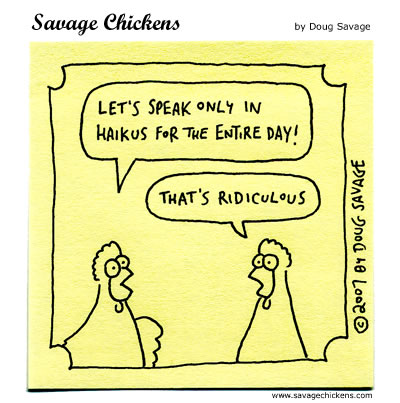
Googley Haiku


Image Source

I've often compared writing search ad copy to conjuring Haiku. Those darn specs can be infuriating! Every time I pen one of these columns I'm reminded how valuable good search copywriters are.

So Few Characters.
Want To Add More Nouns And Verbs.
And Here Is The Blurb...

The New Haiku -- 2010 Edition

Anytime I find myself in a pinch for column fodder, I know I can always fall back on a little Search Haiku. It's not as exciting as covering the search news blotter, but hopefully it will still be as entertaining for you. So here is a fresh new installment of rhymes adding to my collection from '06 and '09.
» 9 Comments

Wednesday, July 14, 2010

Google Me: Why Ask Why?


In today's Search Insider column, I pick up where I left off 2 weeks ago and dissect Google's social media ambitions.

So why is Google so keen on building a large-scale social network? The answer's not as rhetorical as you might think.

Here's the blurb...

Why Google Me

The world may not need another social network. But Google does. Google needs a place where people can easily congregate and communicate. A place that's as easy to understand and use as Google.com. A place that people "like." Why?
» 2 Comments

Wednesday, July 7, 2010

Google Who?

Woe is me for having branded myself (and my wife) with the Google Me moniker. As rumors fly over a Google social network named Google Me, I'm ducking for cover from Google's lawyers (would they really come after someone who just wrote a book singing their praises!?!) and frantically planning modifications to my t-shirt line (available today via KosherHam.com -- get 'em while they're hot... and legal!)

In last week's Search Insider column, I touch on Google Me (the network, not the shirt... well, ok, the shirt too!) in the context of Facebook's move to use the social graph to influence search results. Will flesh out the Google Me piece more in next week's column.

Here's the blurb...

Link Vs. Like And The Future Of Web Ranking

There's been a lot of discussion about the ongoing fight for Web supremacy between Google and Facebook but, to date, the debate has centered around matters like privacy and metrics like page views and ad dollars. In the past week, however, it appears both companies are taking direct aim at the heart of the other's core business. First, AllFacebook.com reported that Facebook launched an "open graph search engine." Then, Kevin Rose sent the blogosphere into, well, the stratosphere with a tweet suggesting that a new Google social network called "Google Me" is imminent. In today's column, I'll dissect Facebook's search aspirations.
» 2 Comments

Wednesday, June 16, 2010

Who's Ready to Get Googley?!?


Image Source

Gotta love that old Snickers ad. "Hey, that's great but who are the Chefs?!?"

Yesterday saw the new website launch for my Google book, Everything I Know about Marketing I Learned from Google, at GoogleyLessons.com.

I'm very pleased with how it came out and must tip my hat again to the good folks at Elevate Studios for the amazing work.

The site is full of content including executive summaries of each chapter, the full text of nearly every interview I conducted while researching the book, as well as the complete book introduction. There's also a blog where I plan to share behind-the-scenes tidbits as well as keep everyone updated on news and info related to the book and its subjects.

One of my main goals for the site is to make reading the book a more interactive experience. Throughout the book I included URLs for people to click on e-readers and/or type in to their browsers to get more context for a particular topic. And I set up specific URLs for each chapter for readers to share thoughts and exchange ideas with others.

My hope is that the book will become much more than the paper -- and, as the case may be, digital ink -- it's printed on. As noted in Chapter 17, "Show of Your Assets," it's always a best practice to extend the shelf life of your products through digital asset creation and distribution. This website is one small way I'm looking to practice what I preach. Other tactics include a promotional video I'm shooting tomorrow along with a blog tour around the book release date (which is set for 8/27, btw) -- both of which were concepted and being executed by my publisher, McGraw-Hill.

When you have a few minutes -- or hours -- to spare, please check out the Googley Lessons website and, if you haven't already, pre-order the book and engage in the conversation.

And, if you like the shirt below better than the one up above, feel free to pick one up -- choose from 20 color combinations! -- through my pals at KosherHam.com.


Remember, Googley is as Googley does. And who doesn't want to get Googley every now and then?!?

Google's Invitation to SEM VIPs

Image Source

In today's Search Insider column, I invite those in the SEM community to RSVP to Google's proposition to buy online display media in a more search-like manner through its latest acquisition, Invite Media.

I didn't touch on this in the column but another interesting thread related to the Invite Media deal is that Google now owns an ad network and ad exchange as well as an ad server (DoubleClick) and demand side platform (Invite) that can be used to buy inventory (and see rates among other data) across other (non-Google) networks and exchanges.

Nat Turner, Invite Media CEO, himself said that this was a huge conflict of interest just a few short months ago. In his guest post on AdExchanger.com about "True DSPs", he wrote...

"A true DSP must remain neutral and have zero allegiances to any publishers, exchanges, data providers or other vendors. A true DSP should embody the word 'platform' and not just be conduit or pretty interface to a pre-existing business."

And, as if that didn't make it clear enough, he went on to say...

"The DSP should not, under any circumstances, own or operate an ad network. This is in direct conflict with the neutrality aspect."

Will be interesting to see how this is resolved.

Meanwhile, here's the blurb from my column...

Google Invites SEM Attributes To Display

In the display world, Google has fared pretty well of late. YouTube will turn a profit this year. And the Google Content Network enjoys 80% reach globally, becoming a staple on most every media plan that includes online ad networks. And Google's success in display can be largely attributed to incorporating key features of SEM.
» Comments

Thursday, June 3, 2010

Googley Tube

Google TV

In yesterday's Search Insider column I pontificate on the ideal ad format for Google TV.

As you might guess, I advocate for taking lessons learned from SEM and applying them to the big screen.

Let's hope Google doesn't act like a bunch of n00bs when incorporating ads onto the boob tube.

Here's the blurb....

What Will Ads Look Like On Google TV?

As many of you know, Google introduced Google TV a couple of weeks ago at its I/O developer conference. Details have been posted via Google blog post , intro video, and developer guide. Conspicuously missing, though, was any information about advertising via Google TV. So, on the off chance Google hasn't yet figured out the proper ad format for Google TV, I thought I'd share some suggestions.
» 4 Comments

Wednesday, May 26, 2010

The Big G is Energized

Google EnergyImage Source

A good friend and colleague of mine, Scott Kier of Mosaic EcoSystems, pinged me a few weeks ago asking for my POV on Google's Energy Foray. I turned the question back on him and here was his response (posted with permission). Very intriguing stuff...

"One of the silver bullets in terms of energy efficiency is the 'smart grid' - a power grid that does more than just send a powerful stream of electricity to your home or office or factory for you to tap into. Rather, it's going to involve attaching a network to the grid - or merging the grid entirely with existing data networks.

Consider:

Just about anything that's plugged in - a lamp, a dishwasher, etc... - draws a trickle of power even when turned off. Eliminating that trickle won't revolutionize anyone's electric bill, and fossil fuel energy remains extremely cheap for you and me, so we don't tend to worry about these small moves towards efficiency. But if EVERYONE eliminated that trickle, collectively it significantly moves the needle of overall energy usage. So what needs to happen isn't just turning off the power switch on the appliance, but rather, turning off the outlet it's plugged into. So you need the outlet to be networked so that when you turn an appliance back on, it re-activates the outlet.

Here's another smart grid application: the power company in Las Vegas knew that people were over-cooling their homes. In the summer in Vegas, setting your thermostat to 78 feels the same in the dry air as setting it to 69-70 does here in Chicago. But most people were setting it to 72-74. Well, when it's over 100 outside, cooling those extra 5-7 degrees is a major usage of power. So stimulus money went to providing single-family homes in Vegas with a smart thermostat which allows the power company to set a default temperature. You can override it, but they were convinced that people wouldn't do so when they realized that 78 degrees was perfectly comfortable and saw the result of that on their electric bill. My parents' electric bill last July fell almost $100 year-over-year.

There are tons more, like smart water heaters that shut down when not needed as opposed to running all the time, keeping water hot.

And when most homes have at least supplemental solar and wind power, it's going to take a smart system to know how to optimize the mix of in situ renewables and grid power, in much the same way as a Google algorithm generates placement for paid search and SEO.

Think of the progression from the typewriter to the computer: it gave you and me a lot more to DO, a lot more access to information, it replaced the card catalog at the library with a query, so we could customize our usage of information. Droid and iPhone OS are the distillation of that for mobile usage, and I believe (and HP seems to believe, too, based on the rationale for their acquisition of Palm) that this is the way in which more and more people will interact with their data.

Well, the progression from a dumb power grid that just blasts power and loses a ton of it along the way to a smart grid that, much like a query, will only go where it's needed - will only find the "relevant" destination - will give you and I will many more applications to manage that, just as we have applications to manage our data.

Tom Friedman calls this the 'energy internet': replacing a dumb, manual system with one driven by queries and manipulation of data. This is exactly what Google knows how to do, so as we move into an era where energy and data will be part of the same technological ecosystem... who better than Google to be a leader in an emerging space that will be built as much on a technological, data-driven platform as an industrial one? They have the processes and culture for innovation, many of the core competencies, and the resources to to be ahead of the pack in this next phase and essentially avoid the fate that befell Microsoft when they really fell behind Apple and Google when the game moved on them.

(Yes, I know PC still crushes Apple in market share, but Apple is still viewed as the premium product, and as tablet computing emerges, Apple will narrow that gap dramatically, and Google will further encroach on Microsoft's position as you have Droid-based tablets.)"

Thursday, May 6, 2010

Yahoo Chides Google for Keeping It Simple. Who's Stupid?


I came across this video in my Facebook news feed thanks to my friend who runs the self-titled "Geoff DeMars Internet Marketing News" page on FB.

The crux of this video and Yahoo's new campaign can be summed up in these 2 lines...

"There's nothing to look at but a box and a button... you come to this place so you can leave."

"At Yahoo, we've got another idea... a place you want to stay."

In his post, Geoff linked to this piece on Search Engine Land in which Yahoo's approach is called "misguided and off the mark" by Greg Sterling and "stunningly stupid" by Danny Sullivan.

For what it's worth, I see merits and demerits to this strategy...

Merit: Yahoo realizes it can't compete with Google and is trying to position itself as an entirely different resource.

Demerit: If Yahoo really realized it couldn't compete in search, it wouldn't repeatedly play up its search capabilities in the voiceover.

The bottom line, though, is that there's nothing Yahoo can do about the fact that most advertisers don't want to reach people on a place that "people want to stay."

Rather, as I discuss in Chapter 4 of my book, "Everything I Know about Marketing I Learned from Google," advertisers want to reach people when they're in a commercial mindset aka "buy mode." More often than not, that type of intent is displayed by going to a place to find what you're looking for and leave. Hence why Google did $6.7 billion in revenue in Q1 compared to Yahoo's $1.6 billion.

I cover the whole "should I stay or should I go" thread in Chapter 3 of my book and the copy is so darn close to the script in this Yahoo ad I thought I'd better share it now before anyone reads the book in September when it's released and thinks my POV was skewed by the Yahoo campaign.

So here's an excerpt from Chapter 3 -- the first 797 of 3647 words in the chapter, to be precise. Note, this is unedited copy from my original manuscript and, outside McGraw-Hill, no-one else has seen it. Would love any and all feedback.

Chapter 3: Keep It Simple, Stupid

What are you supposed to do on Google.com?

Easy, right? Search.

The big search box surrounded by white space beckons you to do one thing and one thing only.

Search.

When you first told someone else about Google, did you have to explain how to use it? Nope.

How do you think Google became a verb? Simple.

There’s very little ambiguity. Google means search.

Today, this seems like a no-brainer. But, in 1998 this was a novel concept. At that time, the most popular websites more closely resembled newspapers, covering every inch of the page with content and ads.

What you were supposed to do on these sites was less clear. Read articles. Look at ads. Communicate with friends. There was one common goal, though. These websites wanted you to stay -- maybe not on that particular page but definitely on that site.

Contrast that with Google. Google doesn’t want you to stay on its site. It wants you to leave.
And what better way to hammer that idea home that to put a big box in the middle of the page with nothing else around it.

Fade to White

Today Google could command millions of dollars for ads on its homepage. But that would distract you from the task at hand. Searching.

In fact, Google recently went a couple steps further. First, in September 2009, it made the search box bigger. Then, a few months later, it removed everything but the box, logo, and search buttons, only fading in the other menu items, links, and footer upon movement of the mouse.

In a blog post, Marrisa Mayer, Google’s VP of Search Products and User Experience, explained the change as follows…

“For the vast majority of people who come to the Google homepage, they are coming in order to search, and this clean, minimalist approach gives them just what they are looking for first and foremost. For those users who are interested in using a different application like Gmail, Google Image Search or our advertising programs, the additional links on the homepage only reveal themselves when the user moves the mouse. Since most users who are interested in clicking over to a different application generally do move the mouse when they arrive, the ‘fade in’ is an elegant solution that provides options to those who want them, but removes distractions for the user intent on searching.”

Of course, what happens after you search is a different story. In the early days, Google results pages were pristine lists of blue links. Today, they resemble almost every other page on the Web replete with images, widgets, and ads.

This layout is quite calculated, however. Once you’ve already searched, Google doesn’t want you to search again. It wants you to click. On whatever seems most relevant to you at the time. Organic listing. Image. Map. Ad. It doesn’t matter. Just click. Hopefully you’ll have found what you wanted and then come back again to search.

Everything about the way Google lays out its pages screams what it wants you to do. Search. Then click. And repeat.

“Don’t over think it. Sometimes simple creates the best experience.” -- Sean Cheyney, VP,
Marketing & Business Development, AccuQuote @scheyney

Easy Does It

On its corporate website, Google lays out its design principles. One of them speaks to the power of simplicity.

“Simplicity fuels many elements of good design, including ease of use, speed, visual appeal, and accessibility. But simplicity starts with the design of a product's fundamental functions. Google doesn't set out to create feature-rich products; our best designs include only the features that people need to accomplish their goals. Ideally, even products that require large feature sets and complex visual designs appear to be simple as well as powerful. Google teams think twice before sacrificing simplicity in pursuit of a less important feature. Our hope is to evolve products in new directions instead of just adding more features.”

In June of 2000, Google stuck a deal with Yahoo! to power its search results. But, despite returning the exact same results, more and more people flocked directly to Google.com when they wanted to find another website. Why? Simple. Google meant search. Yahoo! meant stay.

As Kenneth Fadner, Chairman and Publisher of MediaPost and one of the founders of Adweek, observed, “Yahoo's search was always buried inside its cluttered portal page. When people thought "search" they thought about Google, even while on the Yahoo page, where they could also search using Google. It was not the promise of a better result that moved them, it was the inability of people to hold multiple thoughts in their heads at the same time that made them think: ‘If I want to search I need to go to Google.’"

It was that simple.

Wednesday, April 28, 2010

Apple Signals Sea Change, Buys Siri

Today brought word that Apple bought Siri, a virtual personal assistant that I cover in detail in chapter 21 of my book. Siri CEO, Dag Kittlaus, was kind enough to grant me an interview as I prepared my manuscript. Little did I know -- or did he let on -- what was cooking behind the scenes.

WSJ has good coverage of the news. Will share my POV in next week's Search Insider column. For now, just wanted to call everyone's attention to this latest development in the Google/Apple saga. One day we'll point to this and say this was the moment Apple threw down the search gauntlet.

More on how these two are tangoing in my recent post on the Connectual blog, including a press mention in MediaPost speculating about Google's hire of a new "Developer Advocate."

Thursday, April 15, 2010

My Search Story


If you're a regular reader/follower, you know I have a proclivity for vanity searching. Heck, my Facebook profile pic is of me in a t-shirt I made that says "Google Me." (By the way, I'm teaming up with KosherHam.com to sell a new version of these shirts as part of the promotion for my upcoming book.)

So it should come as no surprise that as soon as heard about Google letting people create their own Search Stories -- via David Berkowitz who made one of his own on ego searching -- I had to do the "Aaron Goldman" version.

Unfortunately, just a few days ago some Aaron Goldman impostor commented to the Boston Globe about layoffs in the Newton mayor's office. This bumped my quote in MediaPost from the top spot for my name on Google News to #2. I'm happy to report that I'm still #1 for every single other vertical search category on Google, though -- web search, image search, blog search, product search, and maps.

Go ahead... Google Me!

Sunday, March 28, 2010

Who's Counting?

Image Source

As stated in my previous Search Insider column -- What Assorted Marketing All-Stars Learned From Google -- the goal for my last installment was to catch the Duggars.

Last week's column -- What 19 Marketers Learned From Google -- squared me up with them, parents and grand-children excluded. Not sure how Michelle did it. My interviews each took only 30-40 minutes, not weeks!

Won't spend much time previewing or pontificating here. My manuscript deadline is 3/31 so it's crunch-time. And, being the glutton for punishment I am, I decided last week to add a 21st chapter titled, "Future-proofing" to discuss what's coming in the next 10-ish years for Google, and marketing in general, along with some tips to help readers prepare.

In my last blog post -- Got It Covered -- I shared some stats on word-count and such in addition to the cover art. Here are the updated figured -- again, pending a few last holes to fill and all the publisher edits yet to come...

Pages: 335
Words: 83,233
Characters (no spaces): 415,942
Characters (with spaces): 497,517
Paragraphs: 2,907
Lines: 6,935

And here's the blurb from my column...

What 19 Marketers Learned From Google

This is the sixth and final column in a series I've been publishing in MediaPost featuring excerpts of interviews I've conducted while writing my book, "Everything I Know About Marketing I Learned From Google." Today, I'll share 140-character-or-less responses from 19 marketing gurus regarding the most important thing they learned from Google.
» 1 Comments

Starting next week I get back to regular posting and bylines -- which means more often and less book-y!

Thursday, March 11, 2010

Got It Covered

Everything I Know About Marketing I Learned From GoogleVery excited to share the cover art for my book. This was created by McGraw-Hill and has some extra white space for glowing endorsements. :)

As far as the manuscript goes, today I cranked out the 20th and last chapter. I'm not done quite yet as there are a few gaps in each chapter that still need to be filled with research, interviews, etc. But, for the most part, the content is complete!

I'm very proud of what I've put together. I think it will make a very interesting, informative, entertaining, and provocative read. I've been very humbled by the support I've received from friends, family, colleagues, blog/byline readers, etc.

And I'm very fortunate to have been granted time and consideration from some 100+ industry luminaries who all participated in Q&A with me to help me prepare the manuscript. Excerpts of those interviews have been running in my Search Insider column and I plan to share more on my soon-to-be newly-designed book site, GoogleyLessons.com, which is scheduled to launch in April or May.

I'm also grateful to the good folks at Elevate Studios for letting me bunker-down in their offices the past few months where I can write in peace and especially for putting up with my machine-gun typing and frantic pacing.

OK, that's enough thanking. Gotta save something for the acknowledgements and dedication!

The book itself will be released August 20-ish but is now available for pre-sale on Amazon, Barnes and Noble, and Borders. I trust you'll find it's the best $17.79, $18.18, or $26.95 you've ever spent!

Here are some quick stats on what I've assembled. (Note: as mentioned above, I still have to plug in some holes and my editors have yet to work their magic. In all likelihood, these figures will get trimmed down quite a bit.)

Pages: 303
Words: 75,571
Characters (no spaces): 375,601
Characters (with spaces): 449,650
Paragraphs: 2,645
Lines: 6,286

(Yes, I've got it saved and backed up in triplicate!)

Look forward to putting this puppy to bed and getting back to biz and blogging! Thanks for your interest and, again, your support!


Wednesday, March 10, 2010

Kickin' It with the Marketing All-Stars

Chuck Taylor All StarsImage Source

In today's Search Insider column I culled my book interviews to catch some quick commentary from a collection of colorful characters. This is my second-to-last column before I come out of hiding at the end of the month and resume original writing.

Over the next three weeks though, I'm looking at a wedding in NY, conference in SF, week vacation in Cancun, and, oh yeah, a book deadline of 3/31 for McGraw-Hill! As I told my colleague, Glenn Fishback of Adify, yesterday, I only know one speed. Giddyup!

What Assorted Marketing All-Stars Learned From Google

This is the fifth in a series of columns I'm publishing in MediaPost featuring excerpts of interviews I've conducted while writing my book, "Everything I Know About Marketing I Learned From Google," Previous installments included a double feature with Paul Gunning and John Battelle. Like the Octomom or the Gosselins, there's no turning back after your first set of multiples -- so, today, I'll offer up 11 marketing all-stars weighing in on the same theme: What makes Google such a unique company? Why has it been so successful?
» 1 Comments

Wednesday, February 24, 2010

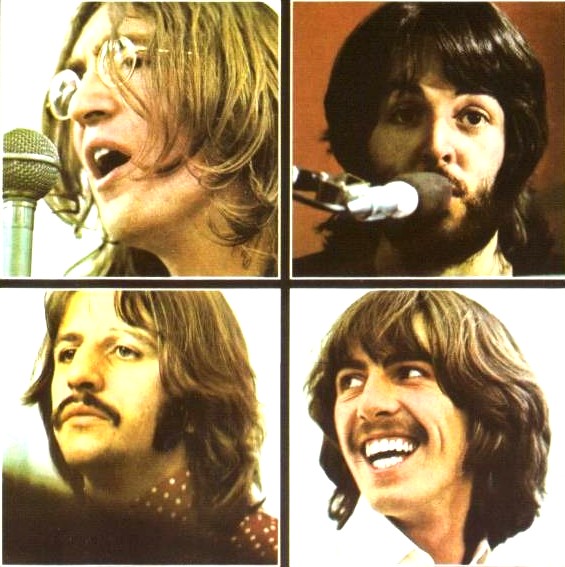
Sound Check with Paul and John; Where's George and Ringo?


Original Image Sources

Today's Search Insider column is a double-feature with sound-bytes from 2 heavy hitters in the space -- Paul Gunning, CEO of Tribal DDB Worldwide and John Battelle, CEO of Federated Media Publishing.

I've been very fortunate to have the support of many influential and insightful industry figures throughout the process of writing my book. I've conducted over 50 interviews to date with another 50+ in the works. It's been challenging to coordinate schedules much less take copious notes and weave them into the running manuscript.

That said, it's been well worth it as the end product will be much more powerful than anything I could've written in a silo. And, to top it off, I've been able to re-purpose the material into some fun Search Insider columns.

Here's the blurb from today's piece...

What Paul Gunning and John Battelle Learned From Google

This is the fourth in a series of columns I'm publishing in MediaPost featuring interviews I've conducted while writing my book, "Everything I Know About Marketing I Learned From Google." Today is a 2-for-1 special with Paul Gunning and John Battelle. Gunning is CEO at Tribal DDB Worldwide. Battelle is CEO of Federated Media (FM) Publishing, and author of "The Search," a book that stands the test of time as the defining narrative on the rise of Google and the importance of search. So, what did these captains of industry learn from Google? Read on...

Tuesday, February 23, 2010

Book Preview

Book Preview in TechJournal South


Yesterday, the TechJournal South posted this brief preview of my book. In it, I share some context around 5 of my 20 Googley Lessons.

FYI, I've now completed 12 chapters totaling 184 pages and 45,00+ words. Hoping to have the first 15 chapters done by the end of the week. Giddyup!

Stay tuned for tomorrow's Search Insider column, which will feature interviews with Paul Gunning of Tribal DDB and John Battelle of FM Publishing.

Thursday, February 11, 2010

All in the Family

Image Source
Was pleased as punch to be quoted in MediaPost along with my little brother, David, opining on Google's Super Bowl ad. Thankfully the punch was not super spiked. More commentary on the Connectual blog. Now we have to find a topic that the entire Goldman bunch can weigh in on!


We're Off to See the Wizard, the Googley Wizard of Biz

Image Source (Magic Google 8-ball mine)

In yesterday's Search Insider column, I ran my interview with Scott Hagedorn and teased him up as the "wizard of biz." Now you can see why.

Here's the blurb...


What Scott Hagedorn Learned From Google

Today, Scott Hagedorn sifts through the sizzle and the steak. Scott is the U.S. CEO of PHD, a global media network under the Omnicom Media Group umbrella. Scott is a digital guy at heart with roles as U.S. Director of Digital at OMD and Chief Interactive Officer at RAPP on his resume. But, above all, he's a self-professed geek when it comes to data, analytics, and technology. In fact, he's been known to bust out 4-D factorial models on spec in new-business pitches. So, what did the wizard of biz learn from Google? Read on...

Saturday, February 6, 2010

Throwing the Book at 'Em

Image Source

Just a quick update on the progress of my book -- aka the reason my blogging has been so light.

On Monday, I turned in chapters 1 thru 10 along with the introduction. The manuscript checked in at 37,158 words -- the equivalent of roughly 150 pages. In all, I've planned for 20 chapters -- one for each Googley Lesson -- so I'm half-way there!

By the time this sucker is edited down, we'll probably be looking at a lean, mean 250 pages which is a good fighting weight for this project -- substantial enough to include a host of case studies and practical takeaways but svelte enough to be a quick read with punchy copy and quick hits throughout.

I'm in the process of redesigning my book website in tandem with the dream team at Elevate Studios. We're looking at a 4/1 launch date for the website which just happens to be one day after my full manuscript is due to McGraw-Hill.

On the new site, I'll share many of the interviews I've conducted with various industry luminaries like Seth Godin, Rishad Tobaccowala, Scott Hagedorn, Scott Shamberg, Matt Spiegel, Quentin George, Paul Gunning, Tony Bombacino, Olivier Lemaignen, Lance Neuhauser, Ed Wise, Penry Price, Jon Raj, Sean Cheyney, Omar Tawakol, and Debra Zahay among others. FYI, I've got another 50 or so currently scheduled so you can be sure I'll be practicing what I preach in chapter 2 when I talk about tapping the wisdom of crowds.

I'll also share excerpts of my manuscript so everyone can get a feel for the book content and tone. (Although, if you're a regular reader of this blog or my Search Insider column, you probably have a good feel for the latter.)

So far, the process has been pretty smooth but definitely more of a commitment than I expected. I've been writing bi-weekly columns for 3 years -- each one clocking in at abut 1,000 words. The goal for my manuscript is 60,000 words so I figured it'd be just like writing 60 columns. I took on the project in late December so I calculated that I'd just need to write the equivalent of 1 column per day in Q1 and I'd hit my 3/31 publisher deadline.

Of course, it's not that easy. For one thing, I don't get a chance to write every day what with my day job and all. And it's much different than writing bylines in that each chapter or sub-section doesn't stand alone. With a column, I can sit down and crank something out in a few hours. With the book, sometimes it takes me half a day just to get my head back to where I left off the last writing session. In turn, I've found the best way to create a cohesive manuscript is to flip on the out-of-office auto-reply and devote entire days and, twice so far, entire weeks to writing.

I also underestimated how difficult it would be to schedule and execute all the interviews. The folks whose brains I'm looking to tap also carry some of the craziest calendars and, at times, it's felt like herding cats. But it's important for me to include a variety of perspectives because I don't think anyone wants to read 250 pages of what Goldman thinks about marketing. Accordingly, I've sought out a mix of marketers, agency wonks, authors, academics, and entrepreneurs to share their POV's.

All in all, I'm very pleased with how the manuscript is shaking out and am very appreciative of all the industry heavyweights that have donated their time and energy to the cause.

Once I turn in my manuscript on 3/31, it goes through an extensive editing and production process and then sales and marketing efforts ramp up. The goal right now is a Fall launch but I'll be emerging from my blogging hiatus in April.

Until then, thanks for all the support and please weigh in on Twitter @GoogleyLessons and let me know what you learned from Google and/or what you'd like to see in the book. I plan on including selected tweets in the book and, for every 100 followers, I'll pick one from the entire list to-date to receive a signed copy.

Now, it's time for this booky to find a bookie and pound the Colts.
Related Posts with Thumbnails