Showing posts with label Yahoo. Show all posts

Thursday, May 6, 2010

Yahoo Chides Google for Keeping It Simple. Who's Stupid?


I came across this video in my Facebook news feed thanks to my friend who runs the self-titled "Geoff DeMars Internet Marketing News" page on FB.

The crux of this video and Yahoo's new campaign can be summed up in these 2 lines...

"There's nothing to look at but a box and a button... you come to this place so you can leave."

"At Yahoo, we've got another idea... a place you want to stay."

In his post, Geoff linked to this piece on Search Engine Land in which Yahoo's approach is called "misguided and off the mark" by Greg Sterling and "stunningly stupid" by Danny Sullivan.

For what it's worth, I see merits and demerits to this strategy...

Merit: Yahoo realizes it can't compete with Google and is trying to position itself as an entirely different resource.

Demerit: If Yahoo really realized it couldn't compete in search, it wouldn't repeatedly play up its search capabilities in the voiceover.

The bottom line, though, is that there's nothing Yahoo can do about the fact that most advertisers don't want to reach people on a place that "people want to stay."

Rather, as I discuss in Chapter 4 of my book, "Everything I Know about Marketing I Learned from Google," advertisers want to reach people when they're in a commercial mindset aka "buy mode." More often than not, that type of intent is displayed by going to a place to find what you're looking for and leave. Hence why Google did $6.7 billion in revenue in Q1 compared to Yahoo's $1.6 billion.

I cover the whole "should I stay or should I go" thread in Chapter 3 of my book and the copy is so darn close to the script in this Yahoo ad I thought I'd better share it now before anyone reads the book in September when it's released and thinks my POV was skewed by the Yahoo campaign.

So here's an excerpt from Chapter 3 -- the first 797 of 3647 words in the chapter, to be precise. Note, this is unedited copy from my original manuscript and, outside McGraw-Hill, no-one else has seen it. Would love any and all feedback.

Chapter 3: Keep It Simple, Stupid

What are you supposed to do on Google.com?

Easy, right? Search.

The big search box surrounded by white space beckons you to do one thing and one thing only.

Search.

When you first told someone else about Google, did you have to explain how to use it? Nope.

How do you think Google became a verb? Simple.

There’s very little ambiguity. Google means search.

Today, this seems like a no-brainer. But, in 1998 this was a novel concept. At that time, the most popular websites more closely resembled newspapers, covering every inch of the page with content and ads.

What you were supposed to do on these sites was less clear. Read articles. Look at ads. Communicate with friends. There was one common goal, though. These websites wanted you to stay -- maybe not on that particular page but definitely on that site.

Contrast that with Google. Google doesn’t want you to stay on its site. It wants you to leave.
And what better way to hammer that idea home that to put a big box in the middle of the page with nothing else around it.

Fade to White

Today Google could command millions of dollars for ads on its homepage. But that would distract you from the task at hand. Searching.

In fact, Google recently went a couple steps further. First, in September 2009, it made the search box bigger. Then, a few months later, it removed everything but the box, logo, and search buttons, only fading in the other menu items, links, and footer upon movement of the mouse.

In a blog post, Marrisa Mayer, Google’s VP of Search Products and User Experience, explained the change as follows…

“For the vast majority of people who come to the Google homepage, they are coming in order to search, and this clean, minimalist approach gives them just what they are looking for first and foremost. For those users who are interested in using a different application like Gmail, Google Image Search or our advertising programs, the additional links on the homepage only reveal themselves when the user moves the mouse. Since most users who are interested in clicking over to a different application generally do move the mouse when they arrive, the ‘fade in’ is an elegant solution that provides options to those who want them, but removes distractions for the user intent on searching.”

Of course, what happens after you search is a different story. In the early days, Google results pages were pristine lists of blue links. Today, they resemble almost every other page on the Web replete with images, widgets, and ads.

This layout is quite calculated, however. Once you’ve already searched, Google doesn’t want you to search again. It wants you to click. On whatever seems most relevant to you at the time. Organic listing. Image. Map. Ad. It doesn’t matter. Just click. Hopefully you’ll have found what you wanted and then come back again to search.

Everything about the way Google lays out its pages screams what it wants you to do. Search. Then click. And repeat.

“Don’t over think it. Sometimes simple creates the best experience.” -- Sean Cheyney, VP,
Marketing & Business Development, AccuQuote @scheyney

Easy Does It

On its corporate website, Google lays out its design principles. One of them speaks to the power of simplicity.

“Simplicity fuels many elements of good design, including ease of use, speed, visual appeal, and accessibility. But simplicity starts with the design of a product's fundamental functions. Google doesn't set out to create feature-rich products; our best designs include only the features that people need to accomplish their goals. Ideally, even products that require large feature sets and complex visual designs appear to be simple as well as powerful. Google teams think twice before sacrificing simplicity in pursuit of a less important feature. Our hope is to evolve products in new directions instead of just adding more features.”

In June of 2000, Google stuck a deal with Yahoo! to power its search results. But, despite returning the exact same results, more and more people flocked directly to Google.com when they wanted to find another website. Why? Simple. Google meant search. Yahoo! meant stay.

As Kenneth Fadner, Chairman and Publisher of MediaPost and one of the founders of Adweek, observed, “Yahoo's search was always buried inside its cluttered portal page. When people thought "search" they thought about Google, even while on the Yahoo page, where they could also search using Google. It was not the promise of a better result that moved them, it was the inability of people to hold multiple thoughts in their heads at the same time that made them think: ‘If I want to search I need to go to Google.’"

It was that simple.

Sunday, October 4, 2009

Yahoo: It's You-ish

What's gotten into the portals these days? First Microsoft launches Bing with an over-the-top commercial essentially blaming the recession on Google. Now comes Yahoo with an ad that would have you believe it can make you into some sort of superhero, leaping tall buildings, making mad cash and endearing yourself to the opposite sex.

While Yahoo didn't go after any of its competitors in this spot, it -- like Bing -- used a barrage of images set to techno music, surely designed to appeal to the short-attention spanned generation that's busy skipping right past Microsoft and Yahoo as they "Google it" to get to their online destination.

Don't get me wrong. I'm actually a big Yahoo fan and think Carol Bartz has it on the right track. I just wish the ad campaign told a story, any story, rather than a generic, "It's all about you message." It's just not enough of a differentiation.

As I said in my review of the Virgin Mobile, "You Rule" slogan, "This slogan could be for just about any brand that's hopped on the bandwagon of personalization in targeting today's self-centered instant gratification generation."

I actually think Yahoo could've used something like "Start Here" -- a slogan that was confusing when ABC used it -- to show that it's finally morphed into a true portal where all your favorite content is neatly organized and no-one's trying to keep you in a walled garden.

The thing that bugs me most about the Yahoo ad is that they actually use the word "consume" to describe how people might use it. For the love of marketing, people don't like to think of themselves as consumers!

Check that, just watched it again... the thing that bugs me most is that it shows 2 pre-teens when it suggests you use Yahoo to "flirt." As a father of a little girl who will be pre-teen in no time, the last thing I want to be thinking about is my daughter flirting with boys online.

And what's up with the harmony on the Yodel at the end? Bring back the country bumpkin! Or, wait a few more months and then I'm sure Kevin Skinner will be looking for paying gigs.

OK, enough ripping on this initial spot. Microsoft seemed to get it right after its manic breakout with follow-up spots that were more subtle and on-point and it appears the campaign is moving the needle on market share so maybe Yahoo's just trying to follow that blueprint and generate some buzz.

Here's the commercial...


And here's my 2 cents on the out-of-home ads...

Yahoo It's You


Update 10/14: Just saw this chart from Silicon Alley Insider (h/t to @LenKendall via @JBCopeland) showing consumer perception of Yahoo pre and post "It's You." Looks like I'm not the only one that this campaign is failing to resonate with.

Yahoo Brand Index Post-It's You

Friday, July 31, 2009

Microsoft-Yahoo Deal Overload

I don't have the time or chops to do it but it would seem like the Bing commercials touting search overload syndrome could be made into a funny parody around Microsoft-Yahoo deal overload.

Over the past few days, it seems like everyone (myself included) and their mother (mine excluded) has weighed in on what the implications of the deal will mean for everything from Google to SEO to local search to oil prices and global warming.

I, for one, have had enough and pledge to limit my coverage (read: obsession) over the deal to just the bare necessities. I welcome others who would like to join me in a vow of celibacy, er... self-censorship.

Everyone else will get Rickrolled!

You know you want to click here

Wednesday, July 29, 2009

Will the Microsoft Yahoo Deal be Good for Google?

Plenty of fish in the sea?
Here's a plotline I haven't seen get much coverage...

Microsoft and Yahoo acknowledge this deal will take time to pass DOJ review and full implementation is "expected to occur within 24 months following regulatory approval."

So what's going to happen over the next 24-36 months? Is Yahoo really going to invest in keeping its search engine up to snuff?

Bartz even said, "With Microsoft powering Yahoo! Search, we’ll be able to focus on the things we do best -– being the center of people’s lives online with properties like our homepage, mail, finance, news, sports, entertainment, mobile, etc."

I'm guessing that focus is going to shift tomorrow, not in 2-3 years.

With Yahoo's search product being left to rot, can it really be expected to maintain its 20% market share? Hardly. And where are those users going to migrate?

It's possible a good chunk of them will go to Bing. In fact, when Yahoo lost 0.5% share in June, Bing gained 0.4% while Google remained flat.

But, surely, Google will pick up some disheartened Yahoo searchers over the next couple years. The question is how many.

It's quite possible that we could be looking at a search pie in 2011 (when, mind you, "full implementation" will still not be complete) that could have Yahoo down to 10%, Bing up to 15% and Google sitting pretty with 70% -- up 5% from its share today.

More interesting threads around this deal in the updates to my previous post -- Bingya!

Update 7/30: Had an interesting back and forth on Twitter with Peter Hershberg, Co-CEO of Reprise Media, that I thought I'd share here. I'll break from tradition (read: laziness) and paste them in top-down chronological order, starting with Peter...

@AaronGoldman POV on Y Search being left to rot is flawed. Y has to invest in case deal isn't approved & to ensure max traffic to monetize.

@hershberg Agree they "have to" but will they? When push comes to shove, where are Yahoo's best tech resources gonna be deployed?

@AaronGoldman There is distinction betw investment in algo and investment in UI. Y prob does more of the latter. Users won't know difference

@hershberg Good point. Bing was really UI upgrade not algo though & it only netted 0.4% share. So if Y algo goes to crap, won't users flee?

@AaronGoldman If users thought it truly went to crap I guess they would. But I have to think there's commitment to MSFT to at least maintain

@hershberg I think the only commitment that matters is the guaranteed payments YHOO is sitting on for 1st 18 mos. ;)

@AaronGoldman Well, I think that would be insanely shortsighted -- even for Yahoo. We shall see...

@hershberg On that we can agree, my man.

Update 7/30 #2: Fortune has a nice interview with Bartz and Ballmer going a little deeper on some of the outstanding Q's around the deal.

A couple quotes from Bartz caught my eye and reinforced my POV that Yahoo is likely to de-emphasize supporting its search product in the short term and prioritize other media and technology projects...

"Over the following 24 months some costs will be reduced."

"But back to the investment: The fact of the matter is that with half a billion people coming every day to a Yahoo site around the world, this actually gives us a better chance to take the money we’re saving and get more audience. We can get more audience because of better properties, stronger entertainment properties. We have all kinds of ideas. We can focus on display advertising technology."

Update 8/3: More good news for Google. Yesterday, the New York Times published an interview with Carol Bartz in which she said, "she sold the search business because Yahoo could no longer continue to match the level of investment Google and Microsoft were making in searching, one of the Web’s most lucrative and technologically complex businesses."

Later the article pointed out that "
Yahoo will lose some of its most talented engineers to Microsoft and as many as 400 employees through layoffs."

I just don't see any way Yahoo will invest in its search product in the near-term. You don't announce a deal like this and then continue to dump money into what you conceded was a business that couldn't keep up.

And even if you postpone the layoffs until after the deal closes, I can't see how Yahoo's top search engineers would just stick around waiting for the verdict. Sure some may go to Microsoft but I'm sure others will flock to Google.

So Google may not only gain share over the next couple years while this deal comes together but it may also gain some intellectual capital.

Tuesday, July 28, 2009

Bingya!

Microsoft Yahoo Search Insemination


Per AdAge, the Microsoft/Yahoo search deal will be announced tomorrow.

Highlights:
  • Yahoo will sell the search advertising exclusively.
  • Microsoft's adCenter will power the search ad platform.
  • Bing will be the default search engine on Yahoo.
No word on what this means for each company's respective display offerings.

Last week I speculated a bit on the deal for a MediaPost news piece and picked up the thread of what they'd call the combined entity on the Connectual blog. On the latter, a commenter suggested Bingya and I must say, I love it!

Pretty sure they'll just use Bing though. Too much $ dumped into that brand to stray.

As for the implications on what this deal means for the search space, for now I'll just say that we should have plenty of time to speculate. Methinks the DOJ will take a hard look at this.

Update: I'm kinda surprised/impressed that Yahoo retained the rights to sell the ads.

It makes sense, though, that Microsoft wants to focus on technology. Its intentions to sell off Razorfish speak to the fact that it recognizes its core competency is tech not media or advertising.

Yahoo, on the other hand, is a media company first and foremost. Retaining the ad sales aspect will allow it to do some cool things in terms of behavioral and search retargeting across its various properties.

Hmm, Microsoft good at technology good, bad at advertising. Yahoo, bad at technology, good at advertising. Where have I heard that before?

Oh yeah, May 2007 when I told MediaPost, "Microsoft and Yahoo are a perfect match for each other... because of Microsoft's historical deficiency in creating scalable digital advertising solutions and Yahoo's corresponding deficiency in creating scalable technology solutions to deliver better advertising. Bring these two together and you have a company that can excel on both sides of the equation."

More on that thread in this post on the Resolution Media blog from Feb. '08 -- back when we were still calling it Microhoo.

Update 7/29: It's a done deal! Here are the terms:
  • 10 year contract
  • Yahoo uses Bing
  • Yahoo keeps 88% of all rev.
  • Yahoo has right to "sell ads on some Microsoft sites"
Apparently, Yahoo expects the deal to "boost its annual operating profit by $500 million."

Of the many Q's this deal raises is what will become of Yahoo's paid inclusion platform? For the sake of all the businesses that were built on top of YSSP (eg, trusted feed partners) I hope they keep it intact. More to follow.

Update 7/29 #2: Another burning Q is how they will combine the 2 sales teams. I have good friends and colleagues on both sides and, for their sakes, hope there isn't any attrition. But I can't imagine how everyone would keep their jobs given that Yahoo and Microsoft each have salespeople calling on the same accounts and agencies. Can't see how they justify doubling up especially as the combined entity becomes even more of a must-buy (read: easy sell).

Update 7/29 #3: Just as Google did when it announced its deal with Yahoo, Microsoft has a site designed to proactively address any Q's about competition and other issues the DOJ may have -- ChoiceValueInnovation.com (excuse me, I just threw up a little in my mouth there).

The site does contain some more interesting nuggets about deal terms:

  • MSFT and YHOO will handle display separately
  • YHOO will "own" the UI for search (guess we won't see those pretty Bing homepage pics on Yahoo.com)
  • MSFT will guarantee revenue to YHOO for the first 18 months
  • Full implementation "expected to occur within 24 months following regulatory approval
Update 7/29 #4: Just posted my thoughts on another looming Q -- Will the Microsoft Yahoo Deal be Good for Google?

Update 7/29 #5 (Well, technically it's 7/30 now): Decided to turn this list of unanswered questions into a more complete post (my second Top Ten list of the day) on the Connectual Blog: "Yahoo Microsoft Search Deal: 10 Most Interesting Plot Lines."

Update 8/5: eWeek scoured Yahoo's 8-k filing to reveal some interesting deal terms:
  • Yahoo may terminate the deal if Bing's revenue per search is less than Google's
  • Yahoo gets first right of refusal if Microsoft decides to sell its search business
  • Both sides can kill the deal if its not consummated by 7/29/10
  • After 5 years, Microsoft will have the option to terminate Yahoo's sales exclusivity (and bump its rev share to 93%)
  • Microsoft will pay Yahoo $150mm over the next 3 years to cover "transition and implementation costs." (Not quite the "boatloads" of upfront cash Yahoo stockholders were expecting.)
  • Microsoft must hire 400 Yahoo employees plus 150 for "transition services"

Wednesday, May 20, 2009

Is Twitter to Facebook as Google is to Yahoo?

Normally, I don't re-post my entire Search Insider Column to this blog but the last 200 words of today's piece got cut off on Media Post so here's the full version...

Is Twitter to Facebook as Google is to Yahoo?

This analogy came to me at the recent Search Insider Summit during the Day 2 keynote conversation moderated by Gord Hotchkiss with Gian Fulgoni and Jordan Rohan. As always, these SIS-staples delivered many provocative thought-starters but I perked up when they started discussing the opportunity for richer brand experiences on the search engines.

History Lesson

Jordan said that what made Google so popular at first was its sparse page with just a search box and textlinks during a period when the trend was towards meta-cluttered portals. Over time, Google evolved its search results pages to include images, video thumbnails, maps, etc. but stopped short of overtly promoting brands beyond text ads. Jordan argued that incorporating any richer ad unit on the SERP would likely cause consumer-backlash.

I quickly wrote up a post for the MediaPost Raw Blog titled, "It Ain't the Blue Links," suggesting that what made Google so popular wasn't its clean white page with simple blue links but its incredible algorithm and relevancy. I closed with this thought -- "The lesson learned from Google is not just simplicity, it’s automation, crowdsourcing and, above all, relevance."

Lesson Learned?

Google was not the first to do search. That honor goes to Archie. And many other search engines came and went before Google. But Google was the first to take the idea of relevancy beyond mere on-page factors, incorporating an element of crowdsourcing by giving weight to inbounds links.

Today, all the major engines take link-juice into account to some extent. However, the 2 biggest contenders for search share after Google -- Yahoo and Microsoft -- still look at search as an add-on to their core offerings.

Now, let's look at the social networking space. MySpace was the first to reach critical mass (Friendster was close but never tipped) before eventually giving way to Facebook, which came along with what was considered a cleaner UI -- read: less graphics, images, audio and other junk -- and more relevancy -- read: less garage bands, porn, and sexual predators.

But what was it that everyone really liked about Facebook? It was the ability not just to connect with people you actually knew -- it was that you could know what they were doing at all times. The status updates were the golden goose.

Over time, though, Facebook began to become more portal-like. It added more tabs, boxes, app's and pages for brands to market themselves. It rolled out advertising programs that, at best, cluttered news feeds and, at worst, offended people. Oh yeah, and then there was that whole Beacon thing.

Paying Attention?

So, along came Twitter, taking the best of Facebook and stripping out the rest. As @ev and @biz told the hosts on the View, the idea for Twitter was hatched as (and I'm paraphrasing here) "a collection of IM away messages."

But they didn’t stop there. Just like Google took what some where doing already and made it better, Twitter put a twist on the idea of status updates by positioning its platform as “micro-blogging.” In turn, rather than just sharing what inane activity they were doing at the time, the Twitterati use their 140 characters to share ideas, POVs, quotes, tips, even RFPs.

As our collective attention span gets shorter and shorter and ADD is hard-wired into our DNA, people will lose tolerance for platforms like Facebook that require multiple clicks to get to the goods. Navigating Facebook is the epitome of Scott Brinker’s Golden Sprinkle.

Heck, people are even losing tolerance for blogs with the average post seeming like a novel compared to a tweet. Case in point -- with this column closing in on 1000 words, I’m sure many of you are thinking you could’ve just gotten the gist by reading the headline and moving on.

Again, there are parallels here back to the search world. In the late 90’s it became clear people no longer wanted to rely on hunting and pecking around a portal assembled by human editors to find interesting information, they just wanted to search for it and have the algo point them in the right direction.

By stripping out all the superfluous features of Facebook, Twitter is more simple and more relevant.

Demerits

So will Twitter do to Facebook what Google did to Yahoo?

Twitter certainly has momentum. Over the past 2 months, its traffic has quadrupled. And it has become pop culture fodder what with all the celebs on Twitter, Ashton reaching 1 million followers, and Oprah getting onboard. And did I mention the founders were on the View?

There's one major hang up, though. While it may have taken the best feature of Facebook and built a company around it, Twitter missed one key point -- you have to own the audience.

Twitter does not own its audience. Applications like TweetDeck and Twhirl do. And while those app providers are beholden to the Twitter API to power their tools, they’re not affiliated with Twitter nor do they share revenue with it.

The fact is, very few people go to Twitter.com. Sure, it may have 17 million monthly visits per comScore but I'd bet there are well over 50 million active Twitter accounts. (Note: as far as I know, Twitter does not release this number.)

Before Google could build out its syndication network and put its toolbar on every browser and desktop, it first got people hooked on Google.com. That afforded it the luxury of dictating terms to 3rd parties that wanted to build on top of it, either by licensing its search results or embedding its ads onto their sites.

Sure, Twitter could just turn off its API one day, locking out all the 3rd party apps and forcing people to come back to Twitter.com but that will surely cause user-revolt -- much worse than if Google subtly introduced display ads on SERPs.

Another major issue for Twitter is monetization. Enough columns have been written on this topic so I’ll spare you my 2 cents other than to say that what made Google so successful was that its monetization engine reinforced its overall mission -- as Marissa Mayer said, “Ads are answers as well.” And, by keeping them relevant (through its Quality Score) Google’s been able to basically print money.

That said, it’s worth noting that Google didn’t rush to monetize either, taking a couple years to build its audience and work out its kinks before running ads.

Homework

So where does this leave Twitter?

Only time will tell if "status updates” or “micro-blogging" are to "social networks" what "search" was to "portals." And it remains to be seen if Twitter will find a way to drive revenue without disrupting the ecosystem.

If, somehow, Twitter can find the right balance of "simplicity, automation, crowdsourcing and, above all, relevance,” it could very well render Facebook the next Yahoo.

Unless, of course, a Twitter-killer like Flutter or Shttr emerges, stripping out just 26 characters or even going down to 10 and ditching the vowels.

Update: MediaPost corrected the error and my full column is now live on the Search Insider site. Some good chatter in the comments section too. Apparently I was not the first to notice the parallels between Twitter/FB and Google/Yahoo.

Sunday, February 22, 2009

Content Match Gone Wrong Part Deux

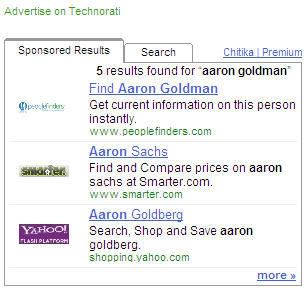
Aaron Goldman Content Match

In part 1 of Content Match Gone Wrong, we saw Google pair an ad for Spam the food (er, can you call that food?) with my Spam email.

This time Yahoo is the offender showing an ad for its shopping channel with the call out to Aaron Goldberg against the keyword Aaron Goldman.

Reminds me of a joke...

2 men were sitting in a bar -- 1 was Jewish, the other Chinese.

Suddenly, the Jewish guy smacks the Chinese guy in the face.

"What was that for?" -- the Chinese dude asked.

"That was for Pearl Harbor." -- the Jew replied.

"Pearl Harbor?!? That was the Japanese, I'm Chinese" -- he exclaimed.

"Japanese, Chinese... it's all the same to me." -- said the Jew.

A little while later, the Chinese guy gets up and smacks the Jewish guy in the face.

"Well, what was that for?" -- he asked.

"That was for the Titanic." -- said the Chinese man.

"You've got to be kidding me," said the Jew, "The Titanic was sunk by an Iceberg!"

"Iceberg, Goldberg... it's all the same to me."

Update 2/23: Having spent over 7 years in SEM, I should have known better but this is likely a case of Broad Match gone wrong, not Content Match. These ads were probably broad matched to the keyword, "Aaron." Hence, why they showed up against the query, "Aaron Goldman."

Tuesday, January 20, 2009

If I Were Running Yahoo -- Revisited

Back in September, I penned a Search Insider column outlining 10 things I’d do if I were running Yahoo. #1 on that list was "Say no to Microsoft once and for all" #2 was “Replace Jerry Yang as CEO.”

Sure enough, last week, Yahoo named Carol Bartz its new CEO. And per WSJ, "Ms. Bartz said in a company-wide Yahoo meeting Wednesday that she plans to spend a lot of time investigating whether to sell Yahoo's search business but that her "gut" was not to do that, according to people familiar with the meeting."

It will be very interesting to see how this plays out. Already 2 of my plans for running Yahoo have come to fruition -- replacing Yang and running display ads on SERPs. Could Roy Bostock be cribbing off my blog posts?

Monday, January 5, 2009

Yahoo Rich Ads in Search: Is the Other Shoe Dropping?

A couple weeks ago I reviewed my 2008 predictions for search marketing here and posted my 2009 predictions for search marketing to the Resolution Media blog.

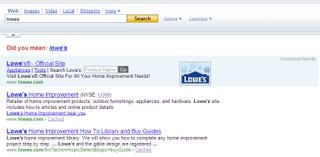
Both lists called for search engines to incorporate display ads on search results pages. Today, one of my colleagues at RM, Dan Kuthy, (who blogs at Blue Chip SEO) pointed me to an image ad on Yahoo SERPs that we're running for our Lowe's client. It's part of Yahoo's Rich Ads in Search (RAIS) platform that embeds site shortcuts and search functionality along with a thumbnail into the sponsored listings space. Right now this placement is limited to brand terms but, with Yahoo struggling to satisfy shareholders and drive revenue (not to mention, innovate ahead of Google), I suspect we'll seem them take this a few steps further.

Here's the ad in context:

Yahoo RAIS

And here's a closeup:

Yahoo Rich Ads in Search

Thursday, December 25, 2008

Reviewing My 2008 Predictions

On Tuesday, I linked to my post on the RM Blog outlining 10 predictions for search marketing in 2009.

Today, I thought it would be fun to review my predictions for 2008 to see how I did. At the end of 2007, I used my Search Insider Buzz-o-Meter column to lay out the following predictions:

1. "Google to bow display ads on SERPs after the DoubleClick deal closes."

2. "More consolidation in the [agency] space, with large shops scooping up specialized search firms as they acknowledge how critical search is to all aspects of marketing and realize how hard it is to build search expertise in-house."

3. "More and more search firms [will] stick a flag in the sand regarding their core expertise -- some will embrace all forms of performance-based media, others will develop full-service digital marketing capabilities led by 'search-think,' and still others will remain true to query-based marketing only."

4. "Facebook to have a major impact on the search marketing landscape in '08, whether it be incorporating Web search (via MSN?), reacting to news feed optimization or spawning regulation around data portability."

5. "A[n economic] pullback could actually be good for search -- when times are tough, marketers load up on platforms with proven ROI -- I also think it could stunt innovation, with the Big 4 unwilling to take chances and upstarts unable to get funding."

6. "Search marketers to figure out how to leverage widgets beyond the mere link-popularity benefits."

7. "The next wave of opportunity is likely in the torso -- after all, as the tail gets longer, the belly gets fatter."

8. "[Microsoft's KSP platform aka AdIntelligence] will make search marketers smarter in '08, and hopefully it will push Google and Yahoo towards becoming more transparent with their data (although I'm not betting on that.)"

Now, to steal a page from Paul Harvey, "for the rest of the story..."

1. Wrong. Didn't happen outside a tiny pocket of experimentation with banners on Google Image results.

2. Sorta. iProspect gobbled up Range Online Media. Publicis snapped up Performics. That was about it though. Instead of acquisitions, we saw a trend towards large agency holding companies infusing resources from their search specialist shops into individual agency brands (eg, WPP creating Group M Search and infusing search talent into Mindshare, Mediaedge, and MediaCom).

3. Right. Search agencies definitely chose sides this past year. As I pointed out in yesterday's Search Insider column, Didit is positioning itself as a "company providing bid management services." 360i kept its "Search-Informed Marketing" approach but acquired creative shop i33 to deliver full-service solutions. Meanwhile, Resolution Media stuck with its laser-focus on Query Marketing (although per prediction #9, look to see expansion here). There were more examples but these 3 check each of the boxes I outlined in my prediction so we'll move along.

4. Sorta. As I suspected, Facebook finally launched web search in tandem with Microsoft but it didn't exactly set the search world on fire. Data portability was a hot topic with the launch of Google Friend Connect but regulation in the space came not from the government as I expected but self-imposed practices from folks like Yahoo shortening the duration of personal data storage to 90 days.

5. Wrong. The recession might not have been bad for search (after all, flat is the new up, right?), but it wasn't good for it either. And innovation among the Big 4 may have slowed but it certainly wasn't stunted. Google rolled out SearchWiki, Microsoft rolled out a number of cool features like Farecast integration and more (see my comments on this post), and Yahoo, despite being battered the most, still managed to roll out Search Monkey as part of its open initiative. Meanwhile, the search for the Google killer continued as startups like Cuil raised cash and launched to very little acclaim.

6. Wrong. 2008 was a big year for widgets, although they're now more commonly referred to as applications thanks to Facebook and the iPhone. Not much application for search marketers though.

7. Wrong. The power of the long tail shone mightier than ever in '08, helping Obama take the White House. There was much debate at the recent Search Insider Summit over the relevance of the long tail to search marketers with no clear consensus. The torso did emerge in a big way this year, just not from a search standpoint. Rather the torso reared its ugly, er, head as vertical ad networks become the "it" thing in online display media.

8. Right. MSFT AdIntel made Resolution Media much smarter search marketers this year. And, sure enough, Google followed suit becoming more transparent with absolute search volume data and a nifty Insights for Search tool.

If I take half-credit for the sorta's, the tally puts me at 38% accuracy. I certainly went out on a few more limbs with my '09 predictions so it will be interesting to see how I fare this coming year. One thing we can all bank on (sorry, bad word choice) for '09 -- it ain't gonna be pretty.

Tuesday, December 23, 2008

What a Difference a Year Will Make

Today I peered into my crystal ball (not to be confused with my Magic Obama 8 Ball) to see what 2009 would bring for the search marketing community.

Below are my 10 predictions. Check out the full post on the Resolution Media blog.

1. Yahoo will be broken up and sold off.

2. Google will offer DART Search for free.

3. Omniture will acquire Covario and incorporate it into its Genesis suite.

4. One of the Big 4 search engines will bow display ads on SERPs.

5. Microsoft will enhance its search results by incorporating the social graph.

6. Google will have a major privacy slip-up and experience serious consumer backlash.

7. Mobile will become a staple of search marketing programs.

8. Search marketers will focus more on post-click activity.

9. Search agencies will expand their offerings beyond “pure” search.

10. I will finally get around to launching GoodSEMBadSEM.com, GoodPPCBadPPC.com, and GoodSEOBadSEO.com.

Monday, November 24, 2008

The Perfect Search Engine

Inspired by Google SearchWiki and a recent conversation with Bryan Simkins from FedEx, I spent some time outlining my vision for crowd-sourced search results on the RM blog today.

Unlike my inagural post on this blog speculating about search in a world of ambient findability, the ideas I lay out for community-driven SERPs are actionable today. Let's see if Google, Yahoo, or Microsoft (soon to be Kumo?) pick up on them.

Wednesday, October 15, 2008

Yahoo to Buy AOL?

2 months ago, I had buying AOL as #2 on my list of Top 10 things I'd do if I were running Microsoft. Looks like the folks in Sunnyvale read my column before the powers-that-be in Redmond got around to it as Yahoo is about to beat Microsoft to the punch again.

Over the past week, rumors have been swirling that Yahoo is close to acquiring AOL for the cool price of $8 billion. This would bring its combined search share up to 25% -- still not within spitting distance of Google but nearly 2.5x that of Microsoft.

The real nut here for Yahoo would be in a bolstered display offering with massive scale for behavioral targeting, search retargeting, and video. Once again, I have to give props to Yahoo for continuing to press forward when it could be ducking and running.

Wednesday, October 8, 2008

Yahoo Beats Microsoft to the Punch

Today Yahoo announced that it was releasing a free web analytics tool. Here's the skinny:

"Born out of our acquisition of IndexTools in May, Yahoo! Web Analytics (beta) provides powerful data and insights reporting that help website owners evaluate their marketing performance and tweak their website designs."

While Yahoo's a bit late to the game here -- Google Analytics has been freely available for quite some time -- it was able to trump Microsoft in this department.

Microsoft has been rumored to have a web anlytics tool in development but, as far as I know, nothing has been released. This seems like a huge miss on their part. Microsoft has many products for businesses and a web analytics tool would be a great add on. It could also help drive usage of adCenter and Atlas if there was seamless integration.

As I mentioned in a recent Search Insider column, making Atlas free and building in web analytics would give it a huge USP over Google and Yahoo.

Only time will tell how the folks in Redmond respond but kudos to Yahoo for not rolling over (despite its share price dipping below $14 -- man, those guys have to be kicking themselves for not taking Microsoft's $33 when it was on the table) and continuing to innovate.

Thursday, October 2, 2008

Stop Me If You've Heard This One...

DMNews today reports on a contract between 2 global leaders in the same category in which one wants to outsource a key service to the other in North America only. In its defense, the company that is being awarded the contract argues that since the deal is a vendor contract, and not a merger or acquisition, it is not subject to antitrust laws. And, furthermore, it claims there will be "vigorous" competition between the 2 companies.

Sound familiar? Anyone else think the folks in Sunnyvale and Mountain View will be keeping a close eye on this one?

Here's the quick and dirty from the DMNews article:

"In a recent letter to the Department of Justice, US Senators Herb Kohl, D-WI, and Sherrod Brown, D-OH, questioned a proposed transport agreement between UPS and DHL, saying the deal would violate antitrust laws.

This comes as an additional hurdle to the proposed contract, which is still being negotiated, and under which UPS would provide air transport services for DHL's North American business for 10 years. DHL said two independent airlines currently provide the services.

Malcolm Berkley, a spokesman for UPS said the deal is a vendor contract and the company does not believe it violates federal antitrust laws.

“This agreement is in no way a merger or an acquisition,” he said. “We will compete vigorously with them in other aspects.”

Wednesday, September 3, 2008

Crazy Game of Poker

In today's Search Insider, I play the hand that Yahoo's been dealt. Below are the 10 things I'd do if I were holding the cards. Sorry Jerry, can't bluff your way out of this one...

1. Say No to Microsoft Once and For All

2. Replace Jerry Yang as CEO

3. Start Developing Original Content Again

4. Buy Kosmix

5. Buy Mozilla

6. Buy Twitter

7. Tear up the Google Search Syndication Deal

8. Run Display Ads on SERPs

9. Charge CPC for Enhanced Natural Search Listings

10. Buy RH Donnelley

So now I've busted Google, flopped Microsoft, and trumped Yahoo. What company should I go heads-up with next? Vote in the poll below.


Related Posts with Thumbnails