This past week, Google announced it was
signing off from the radio space just a week after
closing the books on its print division. I can't help feeling like these decisions were a bit short-sighted with Google caving to investors' insatiable demand for increasing immediate profits, rather than riding out the recession and readying to rule the traditional ad roost.
dMarc was a
$102 million cash (with earn-out up to $1.13 billion) acquisition just 3 years ago. How do you just throw in the towel? I can't imagine the burn-rate was all that high. In its
announcement, Google said it will have to lay off some 40 folks and sell off its "Radio Automation" technology. This company has
nearly $16 billion on cash in hand and over 20,000 employees! Google Audio Ads was but a drop in the bucket. And radio advertising is still a
$20 billion industry.
In the
post-mortem on the Google Traditional Media blog, Susan Wojcicki's said, "Deciding to close products is never easy, but we will continue to focus on advertising products that provide measurability for advertisers, and are relevant and useful for users, listeners and viewers."
So what was the problem with Google Audio Ads?
It wasn't measurability. Per the
Audio Ads AdWords homepage -- "Using call reporting and integrated Google Analytics tools, you can track customer calls, website conversions, revenue, and other metrics to measure the impact of your radio campaigns."
So was it the relevant and useful piece? Hard to quantify but Google seemed to have plenty of
case studies showing positive consumer response. After all, the fundamental promise of opening up traditional media to the long tail was that consumers would receive more targeted messages by having smaller/local advertisers able to play alongside the national bigs.
As for Google Print Ads -- those were hella-measurable what with their 5 trackable calls-to-action and even a
2D barcode. Here's what the bottom of the ads looked like...

Perhaps the real problem was that neither division was able to secure sustainable sources of prime inventory. With publishers and networks leaning more towards Google as
enemy than friend, it wasn't able to procure the type of space that would hold up against the mass budget cuts happening all around us right now.
And that whole bit about accountable advertising being the last to go from the media budget? Not so much. At least not when it came to Google Print and Radio, given that they were still somewhat experimental platforms being tapped by the types of advertisers that are likely feeling the brunt of decreased consumer spending.
So this leaves Google TV as the last traditional format standing. They seem to have had moderate success here,
lining up partners such as NBC Universal. But,
by many accounts, most of the inventory it has access to is remnant. And, with TV advertising still a
roughly $50 billion indsutry, you can bet the folks holding the keys to the prime space are not going to relinquesh them to Google anytime soon.
So is it just a matter of time before Google tunes out of TV and gets back to
what it does best -- "organizing the world's information and make it universally accessible and useful?"
Or will it continue along this parallel-ish path to disintermediate, er... streamline the worldwide advertising ecosystem and make it inherently measurable and valuable?
Or, perhaps the real question is, will Google continue to pander to the Street's demands to stay profitable today or build for the long-term by continuing to gain share one point at a time in traditional media so that, when the recession clouds clear, it is poised to be the top beneficiary from increased ad spending?
Ahhh.... to borrow the old NBA tagline -- I love this game!
Anecdotally, as of today, Google was still running paid search ads for its Audio Ads division:
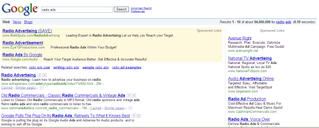

I always wondered who manages Google's in-house campaigns. And how does the algorithm rank their ads? Does Google get a quality score like everyone else? How do they tie back ROI to their campaigns? Could it be that the decision to shutter its Audio Ads division was that the opportunity cost of showing house ads instead of paying advertisers got too high? :)